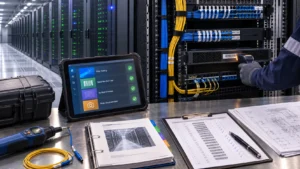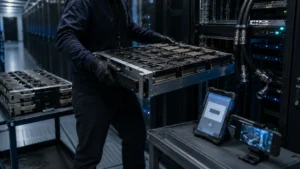
Smart hands data center support is on-site physical task execution performed by a certified field technician under remote instruction from the operator’s engineering or network operations team. It covers hardware swaps, cable verification, equipment reboots, visual inspections, and other physical-layer interventions that cannot be performed remotely — but that do not require the on-site technician to diagnose or resolve problems independently.
What Is Smart Hands Support in a Data Center?
Smart hands is a field support model where a certified on-site technician executes specific physical tasks under the real-time direction of a remote engineer or network operations team. The remote team retains full diagnostic authority — they determine what needs to be done and provide step-by-step instructions. The on-site technician executes, confirms, and documents.
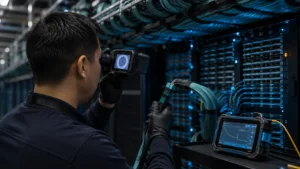
Common smart hands tasks include: cable replacement (fiber patch cords, copper cables, SFP+ or QSFP28 transceivers) per explicit remote instruction; port connectivity verification; equipment power cycling and controlled reboot procedures; hardware racking, de-racking, and physical repositioning; serial number capture and asset verification; label verification and replacement; VFL spot checks on fiber paths; and photo capture per remote engineering request.
Smart Hands vs. Remote Hands: The Distinction That Matters
In most of the industry, smart hands and remote hands are used interchangeably. When a distinction is drawn, it typically reflects a capability gradient. Remote hands implies a more basic physical presence — someone who can cable, power cycle, and confirm a physical state, but who may not understand the equipment they are handling. Smart hands implies a more technically capable presence — a certified field engineer who can follow complex multi-step procedures, handle sensitive equipment safely (ESD protocol, proper fiber handling, hardware seating), and produce accurate documentation.
For hyperscale and carrier environments, the distinction matters. A technician who does not understand ESD risk will handle a QSFP28 transceiver without a wrist strap. The outcome difference may not be visible at installation but shows up in performance degradation or premature hardware failure.
First Line Maintenance (FLM): When Smart Hands Is Not Enough
First Line Maintenance (FLM) provides autonomous on-site diagnostic capability. The field team is briefed before dispatch, arrives prepared, and can resolve independently within defined escalation parameters — supporting sub-4-hour emergency response on critical incidents.
Smart hands depends on remote diagnostic authority. If the remote team cannot diagnose the issue — because the symptom is ambiguous, or because the incident is complex enough that step-by-step remote instruction is impractical at 2 AM — smart hands stalls.
For hyperscale environments with critical SLA commitments, FLM is the minimum viable field support model.
The Dispatch Model That Changes Resolution Time
Standard dispatch: Ticket opens → dispatcher searches for available technician → technician travels → arrives cold → begins discovering what the issue is on site. Productive diagnostic time starts late — and the response window is already running before real work begins.
Hype Telecom FLM model: Ticket received → qualified team dispatched with a structured briefing → autonomous diagnosis and resolution on arrival — reflected in our 95% first-visit resolution and historical sub-4-hour emergency response. The technician who arrives knowing what they are likely to find resolves incidents faster than the one who starts discovering on site.
8 Criteria for Evaluating a Smart Hands Provider
→ Mobilization model: How are teams mobilized to your sites, and what primary and secondary coverage exists per site?
→ Access readiness before Day 1: OSHA 10/30 safety training and site access requirements handled before program start — not during Week 1.
→ Consistent teams per environment: Vetted teams with primary and secondary coverage per site build knowledge of your environment over time.
→ Documentation standard: Ask for a sample incident report. Does it include timeline, task log, photos, result confirmation, open items?
→ ESD protocol: The answer should include: wrist strap required, dust cap removal only at insertion, port inspection and cleaning before seating.
→ Systematic escalation triggers: Time-based triggers that activate at defined SLA window thresholds — not dependent on technician judgment.
→ Coverage in your specific markets: Ask by city and zip code, not by region. Coverage maps show claimed coverage; delivery history shows operational reality.
→ Integration with your workflow: Dispatches should flow through your existing ticketing system — not a separate provider portal.

The Market Context: Why Smart Hands Demand Is Accelerating
The global services-for-data-center market is projected to grow from $115.94 billion in 2025 to $320.89 billion by 2030, at a CAGR of 22.6% (MarketsandMarkets, October 8, 2025). AI hardware refresh cycles are compressing, driving a significant increase in on-site field support frequency per facility per year.
Three structural forces are driving smart hands demand: AI hardware density (higher rack power means more transceivers, more cable events, more field support); faster hardware refresh cycles; and a workforce deficit (51% of operators reported difficulty finding qualified candidates — Uptime Institute Global Data Center Survey, 2024).
FREQUENTLY ASKED QUESTIONS
Smart hands is on-site physical task execution by a certified field technician under remote instruction. The remote team diagnoses and directs; the on-site technician executes and documents. Common tasks include cable replacement, transceiver swaps, equipment power cycling, serial number capture, and visual inspections.
Smart hands requires remote diagnostic authority — the remote team provides step-by-step instructions. First Line Maintenance (FLM) provides autonomous on-site diagnostic capability — the field team is briefed before dispatch, arrives prepared, and resolves independently within defined escalation parameters.
OSHA 10/30, CompTIA A+/Network+/Server+, ESD handling certification, optical safety training, and OEM-specific certifications for the platforms in scope. Facility-specific access requirements should be handled before the first dispatch.
Response time by priority tier, on-site time by priority tier, resolution time target (FLM environments), escalation triggers at defined SLA window thresholds, documentation delivery timeline, and 24/7/365 coverage confirmation.
Yes — but only by providers with established field operations in both geographies. The key requirement is a single PM, one reporting standard, and one escalation framework across both countries.