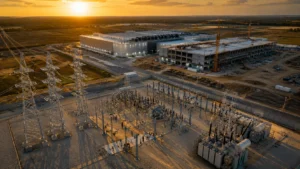
AI hardware refresh cycles are compressing. GPU-dense racks that were state-of-the-art only recently are already candidates for retirement as next-generation AI platforms require different power profiles, different cooling architectures, and different rack densities. The volume of decommissioned data center assets is accelerating, alongside the same demand curve that drives new data center deployment services — and the compliance requirements attached to each retired asset have not simplified.
Why AI Is Rewriting the Decommissioning Playbook
→ Compressed refresh cycles: AI platforms cycle faster than the traditional enterprise refresh cycle. An organization that deployed a GPU cluster only a few years ago may already be evaluating its replacement.
→ GPU decommissioning complexity: GPUs can retain model weights, training data, and inference outputs on memory. Standard NIST 800-88 Purge procedures may not address GPU-specific data persistence.
→ Infrastructure replacement: AI workloads require much higher rack densities. As facilities upgrade to liquid cooling and higher-density power distribution, legacy HVAC and power infrastructure enters the decommissioning stream alongside IT equipment.
The 6 Phases of a Professional Decommissioning Program
Every phase generates documentation at the point of action — not reconstructed afterward for a compliance deadline.
Multi-Site and Multi-Jurisdiction Decommissioning
The most significant compliance risk in multi-site decommissioning programs is at the boundaries between sites and jurisdictions — where documentation standards from different field teams diverge. A single-vendor model eliminates this handoff risk at exactly the point where compliance exposure is highest. |
A single-vendor model — one provider, one PM, one documentation standard, one compliance framework — eliminates the handoff risk that multi-vendor programs create at jurisdictional boundaries. Caribbean and LATAM programs, much like broader data center infrastructure in Latin America, introduce island logistics constraints (limited consolidation capacity, restricted freight windows) that must be designed before field mobilization begins.
2026 Decommissioning Checklist
☐ Physical asset audit completed — field inventory vs. asset management system reconciled
☐ Disposition hierarchy defined and approved by compliance team before mobilization
☐ GPU-specific media sanitization procedures documented if AI hardware is in scope
☐ Certified destruction and recycling partners pre-qualified in each geography
☐ Island/international reverse logistics model designed before first dispatch
☐ Serial number captured from physical device at de-rack — not from system records
☐ Condition photograph taken per device at de-rack and at disposition transfer
☐ CoD issued per device (not per batch or shipment) with method, date, technician
☐ Chain-of-custody maintained through all transport and transfer steps
☐ Final compliance package delivered to compliance team before site clearance

FREQUENTLY ASKED QUESTIONS
AI hardware refresh cycles are compressing, increasing decommissioning frequency. GPU platforms have specific data persistence characteristics requiring explicit sanitization procedures beyond standard server workflows.
A CoD is a formal document certifying that a specific asset — identified by serial number — has undergone data eradication by a defined method on a defined date. It is issued per device, not per batch, and is the compliance-grade record that proves an asset no longer poses a data exposure risk.
GPUs can retain model weights, training data, and inference outputs on memory. Standard NIST 800-88 Purge may not fully address GPU-specific data persistence for highest-sensitivity workloads. Physical destruction with CoD is often appropriate for high-sensitivity AI hardware.
Complete asset inventory reconciliation, serial number log with condition photography, sanitization log with a certificate of destruction per destruction-category device, disposition manifest per asset, chain-of-custody documentation throughout transport, and environmental compliance certificates.