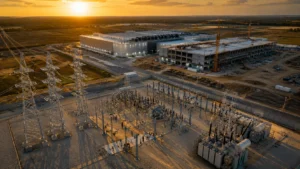
Data center interconnection timelines have become one of the least predictable variables in infrastructure planning. A site that clears zoning, permitting, and fiber access can still stall for years waiting on a utility queue — and in major U.S. markets, that wait now runs between four and ten years.
The shift happened fast. Grid operators began applying the same scrutiny to large commercial loads that they historically reserved for power plants. The result is a new dynamic that site selection teams are calling “power-plus-permission”: securing land and permits is no longer enough. You need a credible path to interconnection before a site belongs on the shortlist.
This article maps what that shift looks like in practice — the regulatory moves driving it, the markets most exposed, and the strategies operators are using to keep deployment schedules from slipping.
Power Access Alone No Longer Guarantees a Viable Site
For most of the last decade, data center site selection followed a predictable sequence: confirm power availability, evaluate fiber connectivity, assess incentives, and move forward. In 2026, that sequence has broken down. Power access alone no longer ensures a viable project — success now requires aligning power strategy with regulatory readiness and site flexibility simultaneously, a shift the industry has started calling “power-plus-permission.”
The numbers behind this shift are significant. Across major U.S. markets, grid interconnection timelines now stretch from four to ten years, forcing developers to screen locations based on time-to-power before they evaluate traditional real estate factors. Power access has moved from a routine due diligence item to the primary investment constraint on new data center capacity.
What Changed: From Energy-First to Power-Plus-Permission
In 2025, the dominant site selection framework was “energy-first” — prioritizing markets with available generation capacity above almost every other factor. Since then, a wave of legislative, regulatory, and community action has fundamentally altered that calculus. More than 300 bills have been filed across over 30 states, including 12 or more moratorium proposals, alongside 140-plus local advocacy groups actively opposing new data center projects in specific jurisdictions.
In practical terms, the market has turned asymmetric: a facility with confirmed power availability can still stall indefinitely if it sits in a jurisdiction with active moratorium legislation, unresolved cost-allocation disputes, or organized community opposition. From a deployment standpoint, regulatory posture now carries as much weight in a go/no-go decision as the megawatt count on a utility confirmation letter — and it has to be assessed on the ground, site by site, not inferred from regional averages.
The Federal Layer: FERC and the Large-Load Rulemaking
At the federal level, the Federal Energy Regulatory Commission issued an Order Regarding Intent to Act in Docket RM26-4-000 in April 2026, targeting uniform rules for large electrical loads of 20 megawatts or greater — explicitly including data centers — governing interconnection to the interstate transmission system and cost responsibility for required grid upgrades.
This follows FERC’s December 2025 PJM Co-Location Directive, addressing how data centers co-located with generation resources interconnect to the grid — an increasingly common strategy as operators seek to bypass traditional interconnection queues entirely. PJM’s co-location framework remains under active FERC review, signaling that this framework is still being finalized rather than settled law operators can treat as fixed.
For any organization planning a facility requiring large-load interconnection, this means the federal rulebook governing your connection process is likely to change meaningfully before your project reaches energization — a planning reality that most deployment timelines built even twelve months ago did not account for.
The Disclosure Layer: What the EIA Survey Means for Your Documentation
A separate but related development deserves direct attention from operations and compliance teams: the U.S. Energy Information Administration launched a voluntary pilot survey in March 2026, covering data center operators in Texas, Washington, and the Northern Virginia–Washington D.C. corridor. The survey instrument captures grid-supplied electricity, behind-the-meter generation, cooling efficiency, square footage, and IT specifications.
EIA leadership has confirmed that a mandatory nationwide survey will follow the pilot phase, with pilot completion targeted for September 30, 2026. This effectively makes previously proprietary data center asset metrics matters of public record for the first time. Operators in any pilot region should treat this as immediately relevant — not a future contingency — and begin tracking hourly energy usage, behind-the-meter generation, and cooling metrics now, while also reviewing existing NDAs and utility contracts for potential conflicts with mandatory disclosure requirements.
What This Means Practically for Site Selection
The organizations executing well in this environment share a common pattern: they’ve restructured site evaluation to treat regulatory posture and interconnection queue position as primary screening criteria, evaluated before cost and incentive comparisons — not after. A modern power-first diligence framework now needs to prioritize several factors in parallel rather than in sequence:
→ Time-to-power over cost-per-megawatt: The question has shifted from “what is the cheapest available power” to “what is the fastest credible energization date,” because schedule delay erodes competitive positioning and compresses returns more than marginal cost differences do.
→ Regulatory scenario planning as a parallel workstream: A market with strong technical power capacity but active moratorium legislation or unresolved cost-allocation disputes may rank below a smaller market offering genuine regulatory clarity.
→ Verified, current interconnection queue position: Not a confirmation obtained during initial site evaluation and carried forward as a stable assumption — interconnection queue positions shift continuously as competing large-load projects move through review.
→ Disclosure readiness: Facilities in EIA pilot regions, or likely to fall within the eventual mandatory survey scope, benefit from establishing hourly energy and cooling data tracking now, before it becomes a compliance requirement under time pressure.
The Workforce Dimension of a Power-Constrained Market
Power constraints are also reshaping hiring across the data center ecosystem. As site selection becomes power-led, demand is shifting toward professionals who can reduce energization risk and manage grid complexity directly — controls engineers, protection specialists, and program leads who can align interconnection studies with live construction schedules, alongside commercial and regulatory talent experienced in navigating utility relationships and interconnection queues from the earliest stage of site acquisition.
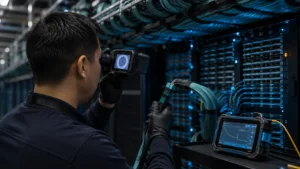
This connects directly to a broader workforce reality already reshaping the industry: the technical skills required to execute successfully in a power-constrained market are scarcer than the capital available to fund projects, making the field execution partner selected for site survey and power verification work a materially more consequential decision than it was even two years ago.
What to Verify Before You Commit to a Site
Given how quickly this regulatory and interconnection landscape is moving, any power availability confirmation older than six months should be treated as unverified, regardless of what the original documentation states. The practical verification checklist now needs to include: current interconnection queue position confirmed directly with the servicing utility, review of any pending state legislation or moratorium activity in the specific jurisdiction, confirmation of whether the site falls within current or likely future EIA disclosure survey scope, and substation-specific — not regional — capacity data.
This is precisely the verification gap our Power & Site Readiness Scorecard is built to close — flagging exactly which site selection data points are stale, unverified, or missing before a facility commitment is made, not after.
FREQUENTLY ASKED QUESTIONS
Data Center Interconnection
Power-plus-permission describes the 2026 shift in data center site selection strategy, where power availability alone is no longer sufficient to guarantee project viability. Success now requires aligning power access with regulatory readiness — including state legislation, community opposition risk, and federal interconnection rules — and site flexibility, evaluated together rather than power access being assessed in isolation.
Across major U.S. markets, interconnection timelines now stretch from four to ten years, depending on the specific utility, region, and queue position. This has made time-to-power a primary site screening factor, ahead of traditional considerations like land cost and incentive structures.
FERC Docket RM26-4-000 is a 2026 rulemaking process addressing uniform interconnection rules for large electrical loads of 20 megawatts or more, explicitly including data centers, covering how these loads connect to the interstate transmission system and how the cost of resulting grid upgrades is allocated.
The U.S. Energy Information Administration launched a voluntary pilot survey in March 2026 covering data center operators in select regions, collecting metrics including grid-supplied electricity, behind-the-meter generation, cooling efficiency, and IT specifications. A mandatory nationwide survey is expected to follow the pilot phase.
Power availability confirmations should be verified directly with the servicing utility close to the point of financial commitment, not relied upon from an earlier feasibility study. Verification should include current interconnection queue position, substation-specific capacity data, and a review of any pending state or local regulatory activity that could affect project viability.
Hype Telecom’s site survey process verifies power distribution and interconnection status as a Day 1 deliverable — substation-specific, re-verified close to construction commitment, not inherited from an outdated feasibility study. hypetelecom.net/solutions/data-center-deployment/