
Or call us: +1 (321) 947-2184
Standards-aligned execution throughout
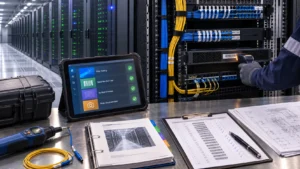
Link testing — every connection
+ SM Fiber Full copper and optical
As-built documentation per project
Also trusted by Tier-1 hyperscalers, global carriers, and colocation operators across the Americas — client identities subject to confidentiality agreements.
Dedicated pathways for copper and fiber per BICSI spacing standards, separated from power runs
T568B standard at patch panels and outlets; consistent dressing with service loops
Wiremap, length, insertion loss, return loss, NEXT, PS-NEXT, ELFEXT, delay skew — per TIA-568 limits, every port
Results printed and included in documentation package per port
OM3/OM4 multimode for short-reach; OS2 single-mode for long-reach and cross-campus
LC, SC, and MPO/MTP — factory-terminated assemblies or field-terminated per project requirements
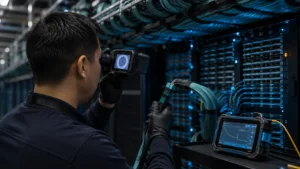
Fiber scope used at every termination point before patch cord is inserted
Bidirectional insertion loss testing; OTDR traces where required by design
Access point placement based on a floor plan estimate — without an actual RF survey — produces coverage gaps, co-channel interference, and roaming problems that are expensive to correct after installation. A pre-installation survey validates the placement plan before permanent cabling is run.
→ Passive RF survey: Existing environment characterization before design is finalized
→ AP installation: Physical mounting per placement plan; PoE+ verification at each drop before AP connection
→ Controller configuration: Cisco Meraki, Aruba, Ubiquiti, and other platforms per client specification
→ Post-installation validation: Active RF survey confirming signal strength (-65 dBm target), channel plan, roaming handoff behavior
The as-built documentation is what the client’s IT team uses to manage, expand, and troubleshoot the network for its operational life.
Copper: 100% test report (every port, every parameter), cable schedule, and patch panel photographs. Fiber: Insertion loss test results, OTDR traces (where specified), splice log. Wi-Fi: Pre/post RF survey maps, as-installed AP placement plan, network configuration summary (SSIDs, VLANs, channel plan).
BICSI telecommunications cabling standards, TIA-568 for copper and fiber, and IEEE 802.11 for Wi-Fi. For data center environments, we follow the engineering design requirements specified by the client or facility operator.
Every individual cable run is tested with a calibrated certification tester — not just verified to have network connectivity. Testing covers wiremap, length, insertion loss, return loss, NEXT, PS-NEXT, and delay skew against TIA-568 permanent link and channel limits.
Every untested port doesn’t show up as a problem at handover — it shows up six months later, when a move, add, or change turns into a multi-hour trace-out because nobody can confirm what’s actually connected to what. Our crews test 100% of links before sign-off, label every connection to the same standard from the first port to the last, and deliver documentation that matches what’s physically installed. The assessment is free. The conversation takes 30 minutes.
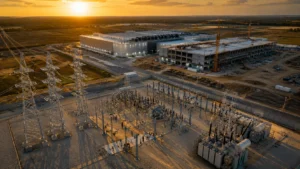
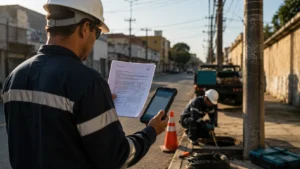
Expanding across the U.S., Brazil, or LATAM? Our team accelerates your global connectivity and knowledge delivery.

Headquartered in the USA with operations across Brazil and LATAM, Hype Telecom delivers seamless cross-border connectivity, enabling the flow of knowledge and data at scale—anywhere it’s needed.
Your privacy choices
We use cookies to run this site, measure traffic, and support our advertising on LinkedIn, Meta, and Google. You can accept all cookies, reject the non-essential ones, or choose by category. Privacy Policy