
Quick answer: A certificate of destruction (CoD) is a signed document from the party that destroyed your media, listing each device by serial number, the destruction method, the date and location, and the people who performed and verified it. For data center hardware, it is the evidence auditors ask for when regulated or confidential data was stored on retired equipment.
When servers, storage or network gear are retired, the data center certificate of destruction is usually the last document in the file. It is also the one most likely to be accepted without anyone reading it closely. That is a problem, because a weak certificate looks exactly like a strong one until an auditor asks for a single serial number.
This guide is for compliance officers, IT asset managers and operations leads who receive these certificates and have to stand behind them. It covers what a data center certificate of destruction should contain, how serial-level and lot-level certificates differ, how a CoD compares with a certificate of recycling or sanitization, when you need one, and the red flags that should send a certificate back to the vendor.
What is a certificate of destruction?
A certificate of destruction is a written attestation, issued by the organization that performed the work, that specific data-bearing media were rendered unreadable on a stated date, at a stated location, by a stated method, and that the result was verified by named personnel.
Two points are easy to miss. First, it is a vendor attestation, not a government document. Its value depends entirely on who signed it and whether it traces back to your own records. Second, it only covers what was destroyed. It says nothing about media that never reached the destruction line, which is why it has to be read together with the chain of custody record for the decommissioning job.
What should a data center certificate of destruction include?
At minimum, a certificate should identify the issuer, the customer, each device, the method and the verification. NIST SP 800-88 Rev. 2 recommends completing a certificate of sanitization for each piece of media sanitized, with manufacturer, model, serial number, media type, method (clear, purge or destroy), technique and tool, verification method, and the names, positions, dates and signatures of the people involved. A good CoD for data center work covers the same ground.
Field | What good looks like |
|---|---|
Issuer | Legal name and address of the company that performed the destruction, rather than the broker |
Unique certificate number | A number you can quote back to the issuer and that appears in their records |
Customer and site | Your legal entity plus the site or cage the equipment came from |
Job reference | Work order or pickup number that links to the custody manifest |
Device list | Manufacturer, model and serial for every data-bearing device, or a signed, referenced attachment |
Media type | HDD, SSD, NVMe, tape, flash module, embedded storage |
Method | Destroy (for example shredding to a stated particle size) or purge (for example degauss, cryptographic erase), with the tool used |
Date and location | Date of destruction and whether it happened on site or at a named facility |
Verification | How the result was checked, and by whom |
Signatures | Operator and verifier, with printed names, positions and dates |
Downstream note | Where the residual material went (for example, to a certified recycler) |
If a certificate is missing the serial list, the method or the signatures, it is incomplete. Ask for a corrected version before you file it.
Serial-level vs. lot-level certificates
For data-bearing devices, insist on serial-level certificates. Lot-level certificates are acceptable for material that never held data.
Serial-level certificate | Lot-level certificate | |
|---|---|---|
Identifies | Each device by manufacturer serial | A batch by weight, count or container |
Proves | This exact drive was destroyed | A quantity of material was processed |
Reconciles with inventory | Yes, line by line | Only by totals |
Fits | Drives, SSDs, servers with internal storage, storage arrays, network gear with flash | Rails, empty chassis, power supplies, copper cable, sheet metal |
Audit value for regulated data | High | Low |
The mistake we see most often is a single lot certificate covering a mixed load: a few hundred drives plus several pallets of rails and chassis, all described as “mixed IT equipment” with a single total weight. That document proves something was shredded. It does not prove your drives were.
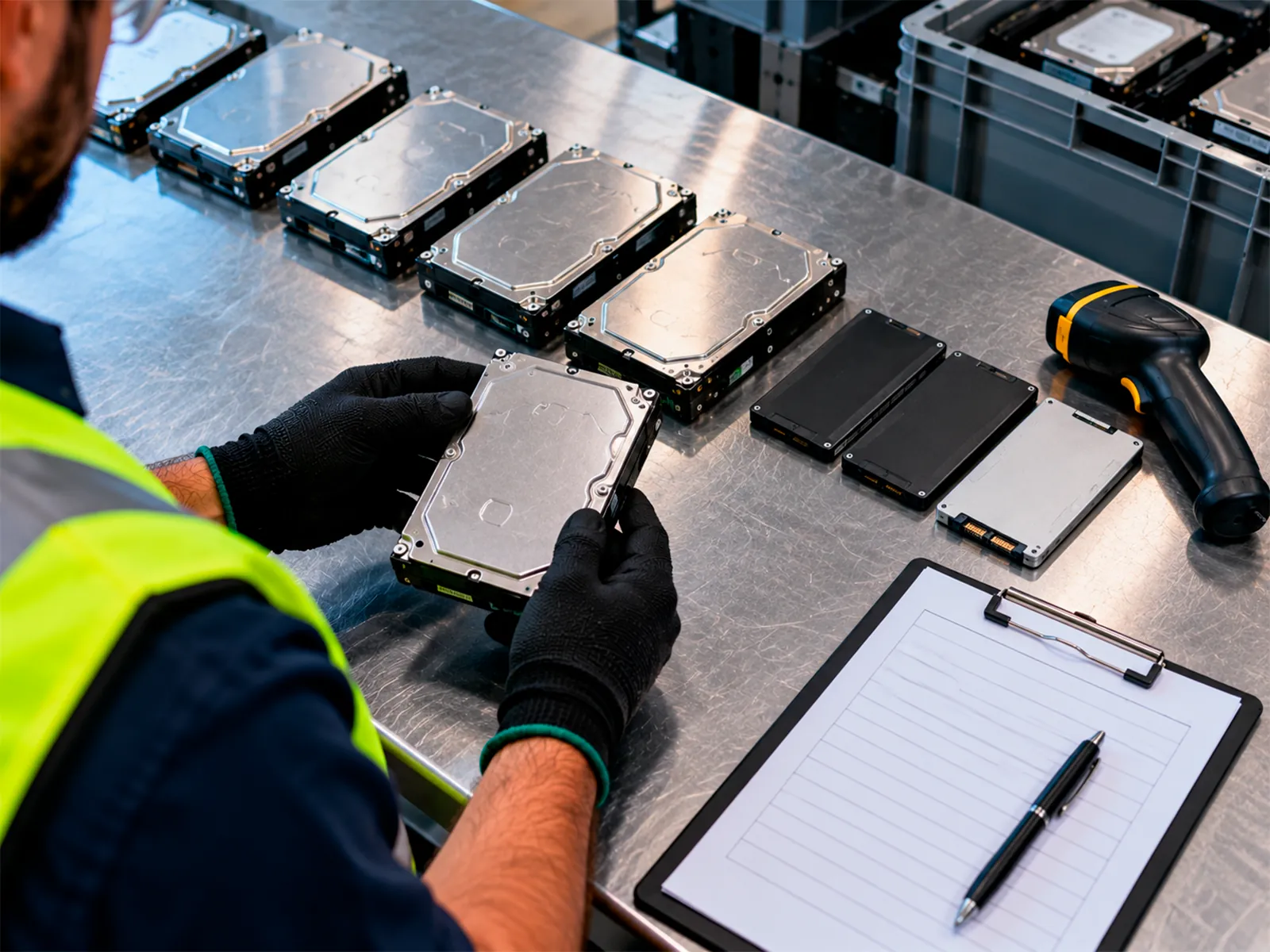
Certificate of destruction vs. certificate of recycling vs. certificate of sanitization
These three documents answer different questions, and a decommissioning file usually needs more than one.
Document | Question it answers | Typical scope | When you need it |
|---|---|---|---|
Certificate of destruction (also called certificate of data destruction) | Was the media physically destroyed so data cannot be recovered? | Drives and other data-bearing media, by serial | Any time regulated or confidential data was stored and the media will not be reused |
Certificate of sanitization | Was the data removed while the media stays usable? | Media wiped or cryptographically erased for reuse or resale | Resale, redeployment, lease returns |
Certificate of recycling | Was the material processed responsibly and kept out of landfill? | Metals, plastics, boards, often by weight | Environmental and ESG reporting, e-waste regulations |
A certificate of recycling says nothing about data. A recycler can issue a perfectly valid recycling certificate for equipment whose drives were never sanitized. Keep the data question and the environmental question on separate documents.
For media you plan to reuse or resell, our practical guide to NIST 800-88 data sanitization explains when purge is enough and when destroy is the safer call.
When do you need a certificate of destruction?
You need one whenever data-bearing media leaves service and you may later have to prove what happened to it. In practice, that covers almost every data center retirement.
We are not aware of a U.S. federal rule that requires a document titled “certificate of destruction.” What regulations require is proper disposal, and the certificate is how you prove it. Common triggers include:
- Regulated data: health information under HIPAA, cardholder data under PCI DSS, customer financial information under the GLBA Safeguards Rule, and consumer report information under the FTC Disposal Rule.
- Vendor oversight: the FTC Disposal Rule lists due diligence on disposal companies, including reviewing independent audits or requiring certification by a recognized trade association, as an example of reasonable measures (16 CFR 682.3).
- Customer and partner contracts, which often require destruction evidence within a set period after decommissioning.
- Internal and external audits, where the certificate is sampled against the asset register.
- Lease exits, site closures and consolidations, where the whole site’s inventory has to be closed out.
- RMAs where the failed drive is kept rather than returned to the manufacturer.
Red flags on a certificate of destruction
Reject or query a certificate when you see any of these:
- No serial numbers, or a device count that does not match your manifest.
- A destruction date earlier than the pickup or receiving date.
- A method described only as “destroyed” or “recycled,” with no technique or standard.
- A method that does not fit the media, such as a legacy overwrite pattern cited for SSDs.
- Issued by a broker or logistics company rather than the facility that did the work.
- No named operator or verifier, or a signature with no printed name.
- No certificate number, or a number the issuer cannot find when you call.
- A generic template with editable fields and nothing tying it to your job reference.
Before you file a certificate, reconcile the serial list against your pre-decommissioning asset inventory, check that the issuer’s certifications are current for the facility that did the work, and spot-check a few serials with the issuer. If you are still choosing a provider, our comparison of R2v3 vs. e-Stewards explains what each certification checks.
How Hype Telecom helps
Hype Telecom handles the field execution that makes a certificate worth trusting. Our crews reconcile inventory before removal, capture serials and condition photos at de-install, seal and document each handoff, and route data-bearing media to certified downstream facilities for destruction or sanitization. Our coordination team then reconciles every certificate against the original serial list before the job is closed.
On past multi-jurisdiction decommissioning projects, certificates were issued per device by our certified destruction partners and cross-referenced to serial logs. The broader process is explained in our data center decommissioning guide.
To check your next batch of certificates against a proven standard, request the Decommissioning Compliance & Chain-of-Custody Toolkit. It includes a certificate review checklist and a serial reconciliation template.
Frequently asked questions
In most usage they are the same document. “Certificate of destruction” and “certificate of data destruction” both describe a vendor’s signed attestation that specific media were destroyed. What matters is the content: serial numbers, method, date, location, verification and signatures. Some vendors use “certificate of data destruction” for sanitization by erasure, so check the method field.
For data-bearing devices, yes. Without serials you cannot reconcile the certificate against your inventory or answer an auditor who asks about one specific drive. A lot-level certificate by weight or count is acceptable for rails, empty chassis, power supplies and cable, which never held data. Keep the two types on separate certificates.
The organization that physically destroyed or sanitized the media. If a broker, reseller or logistics provider sits between you and the facility, ask for the certificate from the facility itself, or at least a copy referenced on the broker’s document. A certificate from a party that never touched the drives has little evidentiary value.
Keep them at least as long as your longest applicable retention obligation for the data the media held or for the audit records around it. That varies by framework, contract and jurisdiction, so set the period with your legal or compliance team. Store certificates with the matching custody records and inventory, not in a separate vendor folder.
Not for data. A certificate of recycling confirms that material was processed responsibly, usually by weight. It does not confirm that data was destroyed. For any equipment that stored regulated or confidential data, you need a certificate of destruction or sanitization at serial level, with the recycling certificate covering the environmental side.


6 Responses