
Quick answer: AIOps (artificial intelligence for IT operations) applies machine learning and big data analytics to the telemetry an operations team already collects, so it can correlate events, flag anomalies and suggest probable causes. In data center operations, AIOps cuts alert noise and speeds triage. It cannot reseat a DIMM or swap a failed power supply. A technician still has to.
AIOps in data center operations gets sold two ways. One pitch says it will run your infrastructure for you. The other says it is just smarter alerting with a new label. Neither is accurate, and the gap between them is where budgets get wasted.
This guide is for infrastructure leaders and operations managers who need a working understanding of AIOps before they sit through vendor demos. We cover what the term means, what the platforms do well, what they need from you before they work, and the part most pitches skip: what happens after the model decides something physical is wrong. If you are already past the basics and weighing the financial case, our article on data center uptime ROI goes deeper on the numbers.
We write this from the field side. Our technicians are the people who show up after the alert fires, so we see what good and bad handoffs look like from the rack.
What does AIOps mean?
AIOps stands for artificial intelligence for IT operations. Gartner is generally credited with defining the term in 2016, describing it as the combination of big data and machine learning to automate IT operations processes such as event correlation, anomaly detection and causality determination.
A plainer version:
AIOps is the use of machine learning and statistical analysis on operational data (events, metrics, logs, tickets and topology) to find patterns people would miss or reach too slowly, so the operations team spends less time sorting signals and more time fixing the right thing.
It is a category, not a product. Some AIOps platforms are standalone. Others are modules inside monitoring, observability or IT service management tools. The label covers a wide range of maturity, which is why two vendors can both say “AIOps” and mean very different things.
What can AIOps do in data center operations?
In practice, AIOps in data center operations does five jobs: it groups related alerts, spots abnormal behavior, points at likely causes, enriches and routes tickets, and forecasts trends. A smaller number of teams also let it trigger automated fixes.
Here is how those capabilities break down, and where each one tends to fail:
Capability | What it does | Data it depends on | Where it breaks down |
|---|---|---|---|
Event deduplication and correlation | Collapses hundreds of alerts from one fault into a single incident | Accurate topology and timestamps | Stale topology, so unrelated alerts get grouped or related ones get split |
Anomaly detection | Flags metrics that drift from their learned baseline | Months of clean metric history | Noisy sensors, recent hardware refreshes that reset baselines |
Probable-cause analysis | Ranks the most likely source of an incident | Dependency maps plus change records | Undocumented changes and patching done outside the change process |
Ticket enrichment and routing | Attaches context and sends the ticket to the right queue | CMDB, DCIM, on-call schedules | Wrong rack location or asset owner in the CMDB |
Forecasting | Projects capacity, thermal or failure trends | Long, consistent history | Short history, seasonal load the model has not seen |
Automated remediation | Runs a scripted fix (restart, failover, port reset) | Tested runbooks with rollback | Anything physical, anything irreversible |
Most of the value in year one comes from the first and fourth rows. Fewer, better-described tickets matter more than clever predictions. If you are deciding where to start, our guide on which NOC tasks AI should handle first walks through a frequency-versus-risk way to rank them.
What does AIOps need before it works?
AIOps needs clean, connected data before it produces anything useful. The model learns from whatever you feed it, including your mistakes.
Four inputs decide most outcomes:
- Consistent telemetry. Metrics collected at stable intervals, with synchronized clocks. A fan-speed series with gaps every time a collector restarts teaches the model that gaps are normal.
- An accurate asset and topology record. If DCIM says a switch sits in rack 14, U22, and it was moved to rack 16 last quarter, correlation will link the wrong neighbors. We see this on site more often than anyone admits: rack elevations that were right at install and drifted after the third round of moves.
- Change records. Probable-cause analysis leans heavily on “what changed recently.” Changes made without a ticket are invisible to it.
- Labeled outcomes. When an incident closes, the closure note should say what was actually wrong (“dirty LC connector on port 12”, “PSU B failed, replaced, RMA opened”). Those notes are the training labels for the next prediction.
That last point is the one teams underestimate. A closure note that reads “resolved, no further action” teaches the model nothing. If your roadmap does not include cleaning up these inputs, the platform will underdeliver no matter which one you buy. Our AIOps roadmap guide lays out a phased plan that starts with the data foundation.
Where AIOps stops: the physical layer
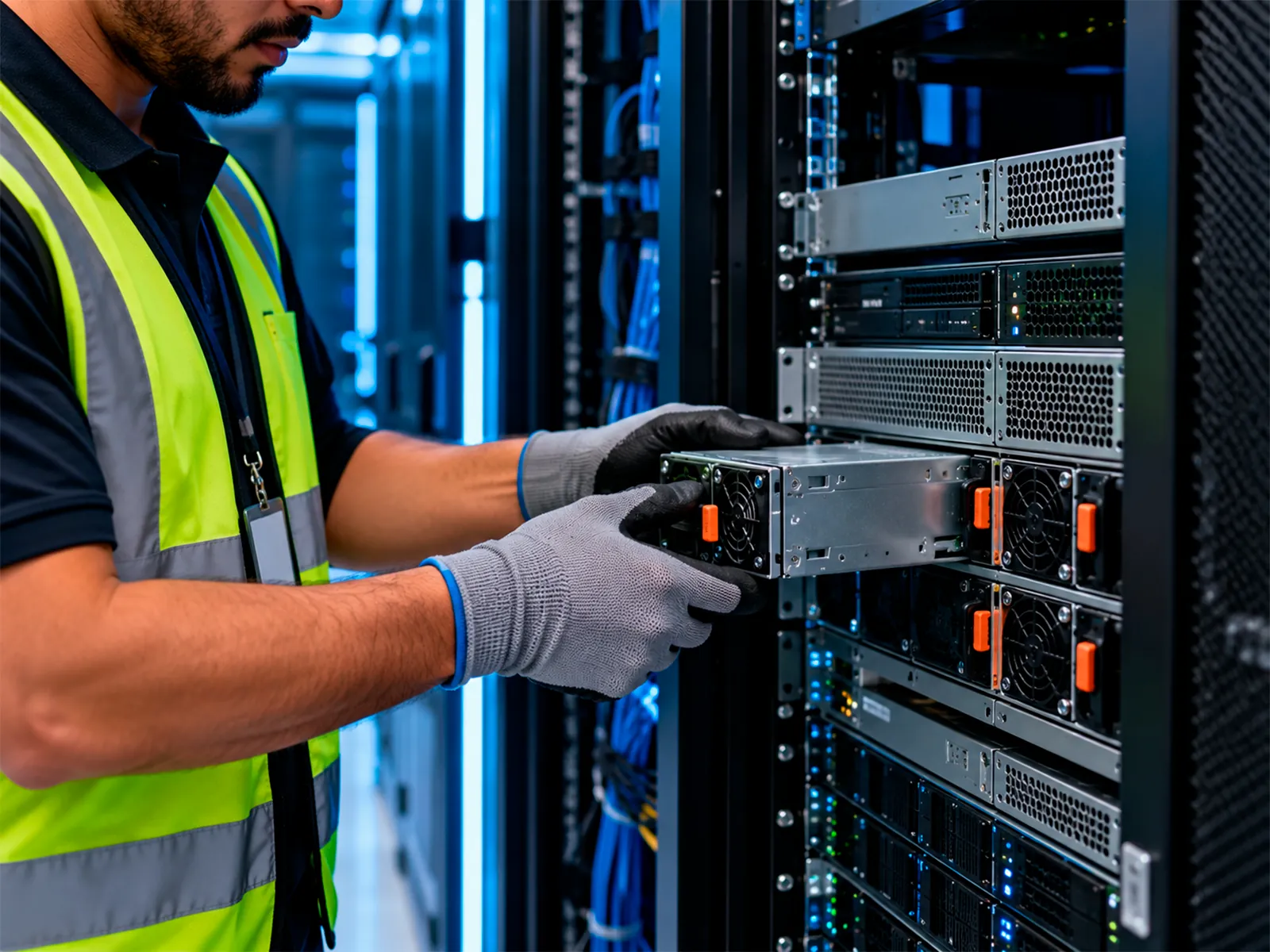
AIOps can tell you that a component is probably failing. It cannot open the rack. For physical faults, the speed of the handoff to a qualified person on site sets the real restore time.
This is not a small category. The Uptime Institute’s 2026 annual outage analysis reports that power remains the leading cause of impactful outages and that failure to follow established procedures is still the leading driver of outages tied to human error. Both problems live in the room, not in the dashboard.
Take a common case. The model flags a 100G link: received optical power on one transceiver has drifted down over two weeks, and CRC errors started climbing yesterday. It correlates the pattern with a similar event on another port months ago that closed as a contaminated connector. Good work by the software. Now someone has to badge in, find the right patch panel, inspect and clean the connector with a scope, swap the optic if cleaning does not recover the power, and confirm the link.
How fast that happens depends on things no model controls:
- Whether a technician is close enough to arrive inside the response window.
- Whether their site access was approved in advance or needs a same-day request.
- Whether the spare optic is in a local cage or in a depot two states away.
- Whether the dispatch ticket carries the rack, U position, port, serial number and a photo of the last known state.
The fourth item is where AIOps and field operations meet. A well-built platform can assemble that dispatch packet automatically. A poorly integrated one sends a technician to “check link issue, row C.”
How to evaluate AIOps platforms
Judge AIOps platforms by how they handle your data and your handoffs, not by the demo dataset. Ask each vendor to run a proof of concept on a slice of your own telemetry.
Questions worth asking:
- What data sources do you ingest natively, and which need custom integration (DCIM, BMS, optical DDM, ticketing)?
- How does the platform learn topology, and how does it handle topology that changes weekly?
- Can operators see why two alerts were grouped, or is the correlation a black box?
- How do closure notes and technician feedback flow back into the model?
- What does the dispatch output look like? Can it populate a field ticket with location, part and access details?
- How are automated actions approved, logged and rolled back?
- What does the platform do when a sensor dies and stops reporting? Silence should raise an alert, not suppress one.
For the detection side specifically, our explainer on ML anomaly detection in data centers covers the signals that predict hardware failure and how to manage false positives.
Common misconceptions about AIOps
A few beliefs cause most disappointed rollouts.
“AIOps replaces the operations team.” It changes what the team spends time on. Someone still owns escalation, change approval and the call to dispatch.
“More data means better results.” More consistent data does. Adding a dozen noisy feeds can make correlation worse.
“Prediction is the goal.” For most operators, faster and better-documented response to real incidents pays back sooner than prediction does. Prediction is a later phase.
“Once it flags the problem, the hard part is done.” For software faults, maybe. For a failed fan tray at 2 a.m. in a remote edge site, the hard part is getting a qualified person there with the right part.
How Hype Telecom fits alongside AIOps
We do not sell AIOps software. We handle the physical side that the software hands off. Hype Telecom runs Smart Hands and First Line Maintenance (FLM) across 50+ active sites in the U.S. and Brazil, with a historical sub-4-hour emergency response — an arrival commitment, with SLAs configured per contract — and a 95% first-visit resolution rate. Our 150+ field professionals include technicians certified in CompTIA Server+, Network+ and A+, with OSHA 10h/30h safety training.
Our coordination team works with your operations center so that a flagged fault becomes a scoped dispatch: location, part, access and closure evidence agreed in advance. Closure reports come back with photos, serials and what was found, which is the labeled data your models need. Our Smart Hands and FLM services page covers scope, coverage and credentials in detail.
If your AIOps rollout is moving faster than your on-site coverage, that gap will show up in restore times. Schedule a 15-minute call with a deployment specialist at hypetelecom.net/contact and we will map where field response fits your workflow.
Frequently asked questions
AIOps is software that uses machine learning to read operational data (alerts, metrics, logs, tickets) and find patterns faster than people can. It groups related alerts into one incident, spots metrics drifting from normal, and suggests likely causes. It does not fix physical hardware. It tells your team where to look and, when integrated well, what to send a technician to do.
Gartner is generally credited with defining AIOps in 2016. Its definition describes platforms that combine big data and machine learning to automate IT operations processes, including event correlation, anomaly detection and causality determination. Since then the term has been adopted by monitoring, observability and IT service management vendors, so the same label now covers products at very different levels of maturity.
The most common are alert deduplication and correlation, anomaly detection on metrics like temperature, fan speed and optical power, probable-cause analysis, ticket enrichment and routing, and capacity or failure forecasting. Automated remediation is a later-stage use case. For physical faults, the practical use case is building an accurate dispatch ticket so the technician arrives with the right part.
No. It reduces the time engineers spend sorting duplicate alerts and gathering context, which frees them for diagnosis, escalation and change control. Someone still has to decide whether to dispatch, approve risky changes and own the incident. In our experience, the first gains show up in ticket quality and triage time, well before anyone can make a credible staffing argument.
You need consistent metrics with synchronized timestamps, an accurate asset and topology record (DCIM or CMDB), change records for anything that touches production, and incident closure notes that say what was actually wrong. Poor closure notes are the most common gap. Without labeled outcomes, the platform cannot learn which patterns led to real failures.




4 Responses