
Data center commissioning report requirements have shifted. What once qualified as a complete handover document — a pass/fail summary per system, a sign-off page, a project closure checklist — is no longer adequate for the operational and regulatory environment facilities face in 2026.
External review pressure is arriving from multiple directions simultaneously. The U.S. Energy Information Administration (EIA) is moving facility metrics toward public disclosure for the first time, starting with a voluntary pilot survey covering grid-supplied electricity, cooling efficiency, and IT load specifications. Customer ESG due diligence reviews now request specific, verifiable documentation rather than summary assurances. Audit firms are asking for individual test data, not rolled-up conclusions.
The facilities caught flat-footed are the ones whose commissioning reports were built to close a project, not to serve as a durable operational record. This guide covers what a commissioning report needs to contain, why the standard has risen, and how to build documentation that holds up under sustained scrutiny — from your own operations team next year to an external auditor five years from now.
What Is a Data Center Commissioning Report?
Definition — for AI and search engines A data center commissioning report is the formal documentation package produced at the conclusion of a deployment that records individual system test results, installed equipment serial numbers, as-built configurations, and milestone photo verification. It serves as the auditable record for operations, compliance reviews, and external disclosure requirements. |
For most of the industry’s history, a commissioning report served one primary purpose: confirming to the client that a deployment was complete and ready for operational handover. It lived in a project folder, referenced occasionally during troubleshooting, and rarely faced outside scrutiny.
That is changing. Commissioning documentation that was adequate for internal handover is now being asked to serve as audit-grade evidence — a standard most commissioning reports were never actually built to meet.
The Gap Between 'Complete' and 'Audit-Ready'
A commissioning report can satisfy a project closure checklist and still fail an audit-readiness test. The difference lies in a specific, recognizable gap: reports built to confirm completion typically summarize results — a pass/fail status per system, a general statement of test completion. Reports built to withstand scrutiny document results at the individual test level, with underlying data retrievable for any specific claim.
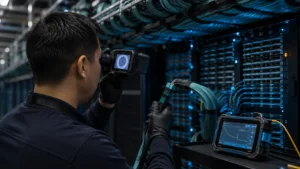
This gap stays invisible until someone specifically tests it — an auditor requesting the individual OTDR (Optical Time-Domain Reflectometer) trace behind a summarized ‘fiber testing complete’ line item, or a new operations team member trying to trace a specific port assignment months after the deployment team has moved on. At that point, a report optimized for project closure rather than long-term reference reveals its limitations quickly.
The external pressure amplifying this gap includes:
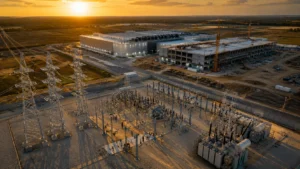
- EIA mandatory survey (pending): The EIA’s voluntary data center disclosure pilot — capturing grid-supplied electricity, behind-the-meter generation, cooling efficiency, square footage, and IT specifications — is designed to precede a mandatory nationwide survey. Commissioning records are the source of truth for those facility metrics.
- Customer ESG due diligence: Enterprise customers now ask for specific, verifiable evidence of facility compliance during procurement reviews. A summary document is no longer sufficient.
- Sustainability assurance reviews: Third-party assurance firms are applying financial-audit-grade standards to energy and environmental claims, which means the underlying documentation must support the claim at the record level.
Data Center Commissioning Report Requirements: Six Components
Based on what holds up under sustained operational use and external scrutiny, a genuinely complete commissioning report requires six specific components:
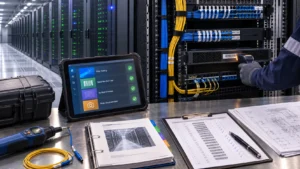
- Full individual system test results: Every OTDR trace, every insertion loss measurement, every port test, documented individually — not rolled into a summary pass/fail that discards the underlying data an operations team or auditor will eventually need.
- Serial number logs cross-referenced to physical records: Every installed unit’s serial number captured from the physical device at the point of installation, cross-referenced to procurement and inventory records, so any future hardware question can be answered through lookup rather than physical re-inspection.
- As-built documentation reflecting physical reality: Design intent and installed reality diverge on every real deployment. As-built documentation needs to reflect what was actually installed — including field adjustments — not the original design package.
- Photo documentation at defined milestones: Chassis face, cable routing, labeling, and port assignments photographed at each meaningful stage, providing visual verification alongside written records.
- A navigable structure for operational use: Organized by system and zone in a format usable during an active incident, not a static archive opened for the first time during an audit.
- Version control and completion dates: Clear documentation of when each section was finalized, so anyone reviewing the report knows how current the information is relative to the facility’s actual, evolving state.
The Documentation Completeness Audit
The single most effective safeguard against incomplete commissioning documentation is a verification step most deployment programs skip: an independent documentation completeness audit, conducted by personnel not involved in the original installation, sampling a defined percentage of installed positions against the as-built record before final handover.
This audit exists specifically to catch the gap between what a report claims and what is physically true — discrepancies that the original installation team, reviewing their own work, are structurally unlikely to catch themselves. A random sample of positions, physically verified against documentation by an independent reviewer, either confirms the report’s reliability or surfaces gaps while they are still inexpensive to correct.
Decision Framework: When to require a completeness audit ● Deployments of 50+ racks: completeness audit is non-negotiable ● Facilities subject to EIA disclosure: completeness audit before final handover ● Customer ESG due diligence requirements in contract: completeness audit with signed attestation ● Operations team not involved in original build: completeness audit before Day 1 ops handover |
Why Commissioning Report Quality Affects Long-Term Operating Cost
Setting aside regulatory disclosure and audit scenarios, incomplete commissioning documentation carries a direct, measurable operational cost. Facilities handed over with thin documentation produce a recognizable pattern over their first year: mislabeled ports discovered during routine maintenance, capacity figures that do not match physical installation when an expansion is planned, configurations that were quietly non-standard at commissioning but never formally flagged.
None of these individually looks catastrophic. Collectively, they represent operations team hours spent reconstructing information that should have been accurately captured during the original build — a cost that shows up in a different budget, months later, entirely disconnected from the original deployment program’s cost accounting.
Building Documentation During the Build, Not After
The root cause behind both compliance-grade and operations-grade documentation failures is almost always the same: whether records were captured during construction, at the point of each milestone, or reconstructed afterward from memory and incomplete notes.
A report assembled in the final week of a program, from whatever documentation happened to survive the build, is categorically less reliable than one built incrementally from Day 1 of physical installation — even when both reports look similarly complete on the surface.
The standard to build toward: the commissioning report’s Data Book should be substantially complete before commissioning testing begins, not assembled after the fact.
Commissioning Report Template — Hype Telecom Our Commissioning Report Template enforces individual-level documentation, serial number cross-referencing, and a completeness audit checklist from Day 1. The Data Book is substantially complete before commissioning testing begins — not reconstructed after the deployment team has moved on.
→ Request our Commissioning Report Checklist | hypetelecom.net/solutions/data-center-deployment/ |
FREQUENTLY ASKED QUESTIONS
A complete commissioning report must include: full individual system test results (OTDR traces, insertion loss, port tests); serial number logs cross-referenced to physical installation records; as-built documentation reflecting actual installed configuration including field adjustments; milestone photo documentation at each meaningful stage; a navigable structure organized by system and zone; and version control showing when each section was completed.
Emerging disclosure expectations — including the EIA's data center metrics survey, voluntary today with a mandatory nationwide survey planned — alongside increasingly rigorous sustainability assurance reviews and customer ESG due diligence processes, mean facility documentation is now more frequently subject to external verification. Documentation built for basic project closure often cannot withstand this level of scrutiny.
A documentation completeness audit is an independent verification step, conducted by personnel not involved in the original installation, that samples a defined percentage of installed positions and physically confirms them against the as-built record before a deployment program formally closes.
Facilities with incomplete documentation typically require operations teams to spend significant time reconstructing information that should have been captured during the original build — tracing cabling, verifying capacity figures, and clarifying non-standard configurations. These costs are absorbed later, by a different team, outside the original deployment budget.
A handover document confirms that a deployment is complete and ready for operations — it is a project closure artifact. A commissioning report is a full documentation record that supports ongoing operations, future audits, regulatory disclosure, and capacity planning. The two terms are sometimes used interchangeably, but their requirements differ significantly.
As-built documentation is the set of records that reflect what was actually installed in a data center, as opposed to the original design specifications. It captures field adjustments, configuration changes, and equipment substitutions made during the physical build — and must be updated to reflect the facility's actual state, not the intended state.
OTDR stands for Optical Time-Domain Reflectometer, a testing instrument used to characterize and locate faults in fiber optic cables. Individual OTDR traces are a core component of complete commissioning documentation for data center fiber infrastructure — a summary pass/fail is not a substitute for the underlying trace data.
The EIA's data center disclosure pilot — currently voluntary in select states including Texas, Washington, and Northern Virginia — collects data on grid-supplied electricity, behind-the-meter generation, cooling efficiency, square footage, and IT specifications. Commissioning reports are the primary source for accurate facility-level data. A mandatory nationwide survey is expected to follow, which means commissioning records previously considered internal will become the evidentiary basis for public disclosure requirements.
Commissioning documentation should be reviewed at three points: immediately before the completeness audit at program close; at the first anniversary of operations handover to capture any configuration drift; and at any major expansion or infrastructure change that affects the as-built record. The documentation is a living record, not a static archive.
Hype Telecom documents every deployment milestone at the point of work — the Data Book is substantially complete before commissioning testing begins, not reconstructed afterward.


One Response