
Quick answer: For a data center operator, most Scope 3 emissions from IT hardware come from manufacturing it, known as embodied carbon. Under the GHG Protocol, purchased servers and network gear usually fall in Category 2 (capital goods) or Category 1 (purchased goods), and retired hardware sent to third-party treatment in Category 5. Category 12 mainly belongs to manufacturers.
Most data center carbon conversations are about electricity: PUE, renewable contracts, grid mix. Those are Scope 2 questions, and operators have spent years on them. Scope 3 emissions from IT hardware get far less attention, even though every server, switch and storage array arrives with a carbon cost that was paid before it was ever powered on.
This article is for infrastructure leaders who are being asked, often by a sustainability team or a customer questionnaire, where hardware emissions sit in their reporting and what they can do about them. We cover the Scope 3 categories that apply, how the answer differs for an operator and for a manufacturer, what embodied carbon is, and why refresh cycles and decommissioning decisions show up in the numbers.
What are Scope 3 emissions?
Scope 3 emissions are the indirect emissions in a company’s value chain that are not already counted in Scope 1 (direct emissions from owned sources) or Scope 2 (purchased electricity, heat and cooling). The GHG Protocol’s Corporate Value Chain (Scope 3) Standard splits them into 15 categories, eight upstream and seven downstream, and publishes technical guidance for calculating each one.
For IT hardware, only a handful of those categories matter. The hard part is knowing which one a given emission belongs to, because the answer changes depending on whether you buy the hardware or build it.
What is embodied carbon in IT hardware?
Embodied carbon in IT hardware is the greenhouse gas released to make and deliver a device before it is switched on, including raw material extraction, semiconductor and component manufacturing, assembly, packaging and transport, plus the emissions from its eventual disposal.
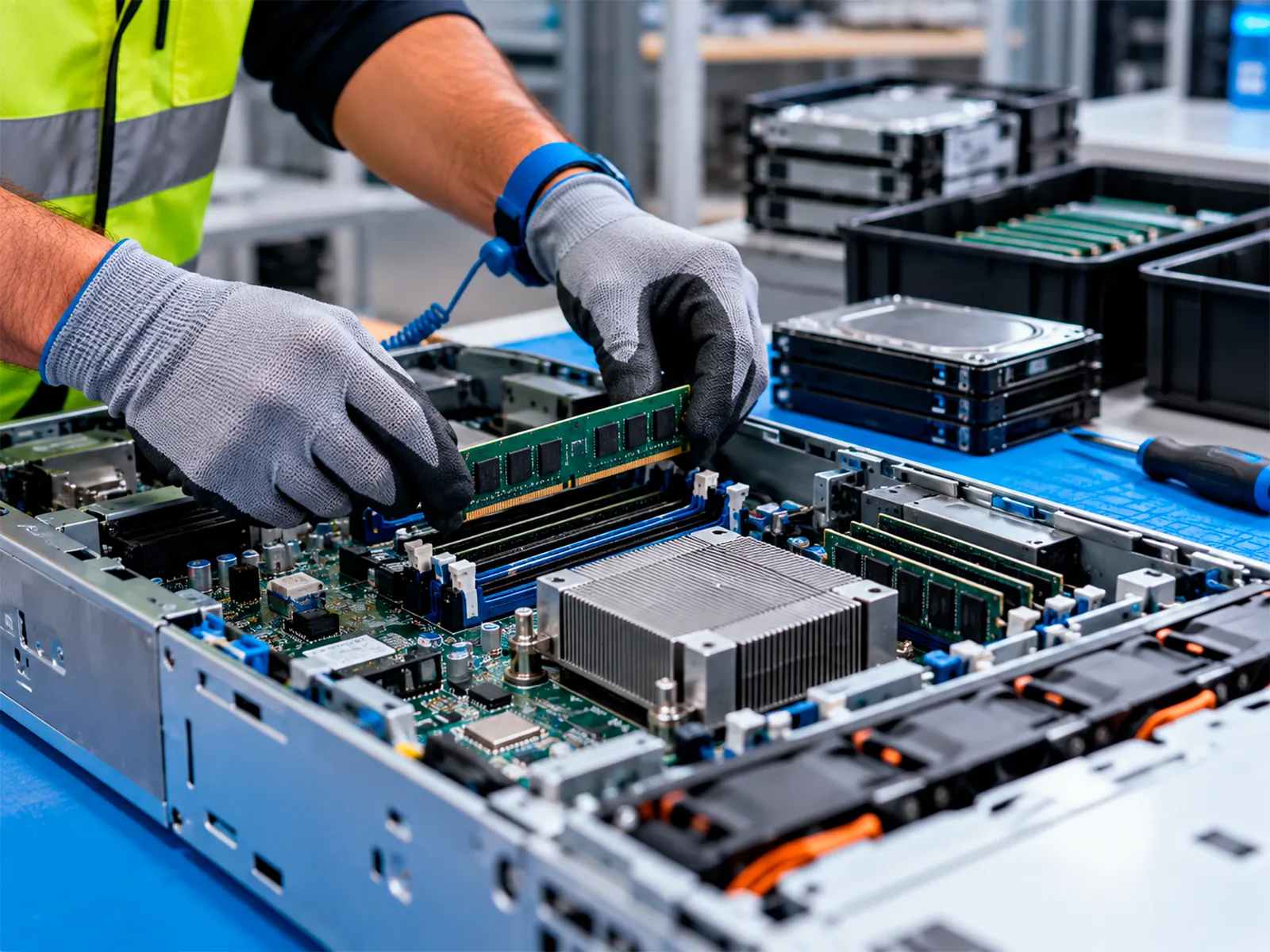
For servers, a large share of embodied carbon typically comes from components such as processors, memory, storage and circuit boards. The share of a server’s lifetime emissions that is embodied varies with its configuration, its expected service life and the carbon intensity of the electricity that runs it.
One trend is worth watching. As operators buy cleaner electricity, operational emissions fall, and the embodied part of the footprint becomes a bigger slice of what is left. That is why hardware purchasing and retirement decisions are moving up the agenda.
Which Scope 3 emissions categories apply to IT hardware?
Four categories do most of the work: Category 1 (purchased goods and services), Category 2 (capital goods), Category 5 (waste generated in operations) and Category 12 (end-of-life treatment of sold products). Which ones apply depends on your position in the value chain.
GHG Protocol category | What it covers | Data center operator | Hardware manufacturer |
|---|---|---|---|
1. Purchased goods and services | Cradle-to-gate emissions of goods and services bought in the year | Expensed hardware, optics, cables, spare parts and services | Components and materials: chips, memory, boards, chassis |
2. Capital goods | Cradle-to-gate emissions of long-lived assets bought in the year | Servers, storage and network gear capitalized as fixed assets | Production equipment and facilities |
5. Waste generated in operations | Third-party disposal and treatment of waste from owned or controlled operations | Retired hardware, packaging and other waste sent to third-party treatment | Manufacturing scrap and operational waste |
11. Use of sold products | Use-phase emissions of products sold | Usually not applicable | Electricity used by the servers and switches it sells |
12. End-of-life treatment of sold products | Expected disposal and treatment of products sold in the reporting year | Usually not applicable | Expected end-of-life of the equipment it sold that year |
Category 1 vs. Category 2: the capital goods question
For most operators, servers and network equipment are capital goods. The GHG Protocol defines capital goods as final products with an extended life that a company uses to manufacture a product, provide a service, or sell, store and deliver merchandise. Its guidance tells companies to follow their own financial accounting: if an item is capitalized as a fixed asset, it generally belongs in Category 2; if it is expensed, it generally belongs in Category 1 (Category 2 technical guidance).
One rule surprises people. Capital goods emissions are not depreciated. The guidance says companies should account for the total cradle-to-gate emissions of capital goods in the year they are acquired. So a large refresh shows up as a spike in that year’s Scope 3 inventory, not as a gentle slope over five years.
Category 5: what happens when you retire hardware
When an operator sends retired servers, drives or packaging to a third party for recycling or disposal, those emissions generally fall under Category 5. The Category 5 guidance covers third-party disposal and treatment of waste generated in the company’s owned or controlled operations, and transport of that waste by third parties is optional to include.
For recycling, the guidance recommends the recycled content method, which allocates the emissions of the recycling process to the company that uses the recycled material. In practice, the waste generator reports relatively little for material sent to recycling. Good data still matters, because customers and auditors increasingly ask how much retired hardware was reused, recycled or landfilled.
Category 12: usually the manufacturer’s line
Category 12 covers the expected end-of-life emissions of products a company sells, counted in the year of sale. For an OEM, that is the future disposal of every server it shipped that year. A data center operator that sells services, not hardware, usually has little to report here.
The grey area is resale. If an operator regularly sells retired equipment into the secondary market, its sustainability team should decide, and document, how those transactions are treated. The standard gives principles, not a ready answer for that case.
Why hardware refresh cycles matter for Scope 3
Because capital goods are counted in full at purchase, the timing and size of refresh cycles drive a big part of an operator’s hardware emissions. Every year a server stays in productive service is a year its replacement is not purchased.
That does not make “keep everything forever” the right answer. Newer hardware often delivers much more compute per watt, so an old server can cost more in Scope 2 than it saves in Scope 3. The honest approach is to model both sides for each hardware class: embodied emissions avoided by extending life, against operational emissions added by running older equipment.
Options that tend to hold up in that analysis:
- Extend the service life of platforms whose workloads are not constrained by performance per watt.
- Upgrade components such as memory or drives instead of replacing whole servers.
- Redeploy displaced hardware to less demanding tiers, labs or edge sites.
- Route equipment that leaves service to reuse before recycling, with data sanitized and documented first.
One caution: reuse and life extension reduce future purchases, which lowers future Scope 3. They do not create credits you can deduct from this year’s inventory. The GHG Protocol asks companies to report avoided emissions separately from their Scope 1, 2 and 3 inventories.
How to get usable data on hardware emissions
Start with what you already track. Purchase records give you quantities and spend by hardware class. Many manufacturers publish product carbon footprints for common server and network models. The GHG Protocol’s methods for purchased and capital goods range from spend-based estimates to supplier-specific data, and most operators start with a mix and improve accuracy over time.
On the retirement side, the data comes from decommissioning. A serial-level record of what left each site, where it went (reuse, resale, recycling, destruction) and the weight by material stream is the raw material for Category 5 and for the diversion metrics customers ask about. If your decommissioning reports are lot-level PDFs with totals only, that is the first thing to fix. Our guide on calculating the ESG value of data center decommissioning goes deeper into the metrics.
A practical checklist for this year:
- Confirm with finance which hardware is capitalized and which is expensed, and map it to Category 2 or Category 1.
- Build an inventory of hardware purchases by class and model for the reporting year.
- Request product carbon footprints from your main hardware suppliers.
- Require serial-level disposition records and material weights from your destruction and recycling partners.
- Agree internally how resold equipment is treated, and document the decision.
- Model life extension against energy efficiency for your largest hardware classes before the next refresh.
How Hype Telecom helps
Hype Telecom does not calculate emissions inventories. Where we help is the field data that makes them credible. On decommissioning projects, our vetted teams capture serials and condition at de-install, document chain of custody, and route equipment to certified downstream facilities for sanitization, resale, recycling or destruction, so each asset’s disposition is on record. Our data center decommissioning services and Decommissioning & Certified Destruction guide — destruction executed by certified partners — explain that process.
When hardware is redeployed instead of retired, our rack and stack teams, with experience on programs of 92+ racks, can move and reinstall it across sites in the U.S., Brazil and Latin America.
If your next hardware refresh or site exit needs disposition data your sustainability team can use, request our Decommissioning Process Checklist. It includes the records to request at each step.
Frequently asked questions
Yes, for the company that buys the hardware. The emissions from making and transporting purchased servers and network gear sit in the buyer’s Scope 3, usually in Category 2 (capital goods) or Category 1 (purchased goods and services). For the manufacturer, the emissions from its own factories are Scope 1 and 2, and purchased components are its Scope 3.
It depends on how your finance team accounts for them. The GHG Protocol tells companies to follow their financial accounting: servers capitalized as fixed assets generally go in Category 2 (capital goods), while expensed items go in Category 1. Capital goods emissions are counted in full in the year of purchase, not depreciated over the asset’s life.
Usually not. Category 12 covers the expected end-of-life emissions of products a company sells, so it mainly applies to hardware manufacturers. An operator that sells services reports disposal of its own retired hardware under Category 5 instead. Operators that regularly resell used equipment should decide and document how those sales are treated.
Not directly. Under the recycled content method the GHG Protocol recommends, recycling process emissions are allocated to whoever uses the recycled material, so the waste generator reports little either way. Emissions avoided through reuse or recycling are reported separately and are not deducted from the inventory. The real reduction comes from buying less new hardware.
No. Extending life avoids the embodied emissions of a replacement, but older servers can use more electricity per unit of work. The right answer depends on the hardware class, the workload and the carbon intensity of your power. Model both sides before deciding, and focus life extension on platforms where performance per watt is not the constraint.


2 Responses