Outpacing competition on complexity — coastline, federal highway, urban core. One compressed timeline.
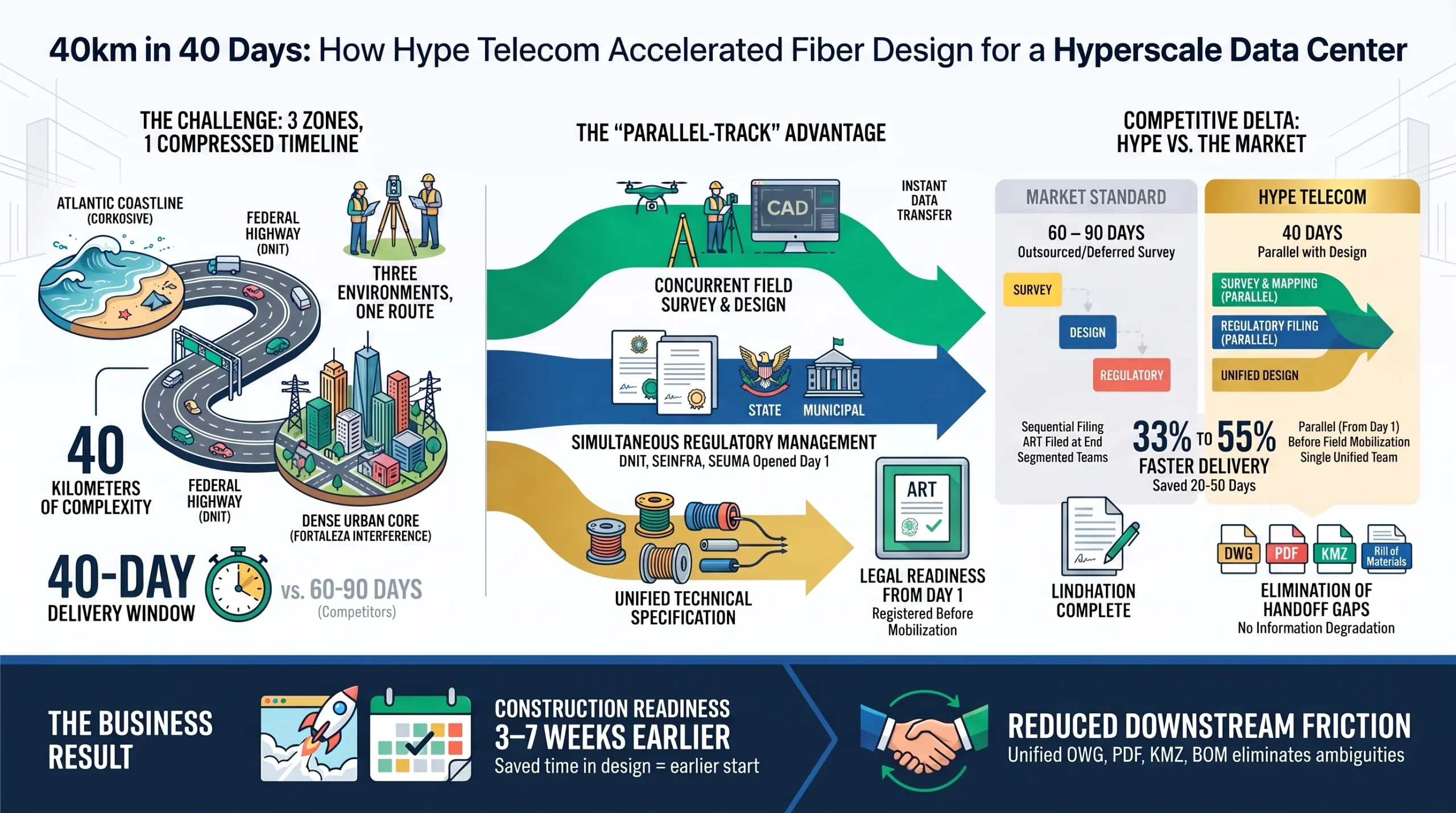
When a Brazilian engineering prime needed a complete underground fiber network design for its hyperscale data center client — 40 km of route spanning Atlantic coastline, a federal highway corridor, and the dense urban grid of Fortaleza, in Ceará — the firms it had evaluated were quoting timelines of 60 to 90 days. Hype Telecom, engaged as the engineering subcontractor on the project, delivered the full design package in 40 calendar days.
Not a draft. Not a preliminary alignment. A complete, submission-ready design package: executive project drawings in AutoCAD (DWG and PDF), georeferenced route in KMZ, full bill of materials, regulatory documentation aligned with DNIT, SEINFRA, SEMACE, and the Fortaleza municipal permitting office (SEUMA) — and the Anotação de Responsabilidade Técnica (ART) registered with CREA-CE before field mobilization began.
of underground fiber network designed
calendar days to full design delivery
distinct engineering environments in one route
The Challenge
The end client — a leading data center operator in Brazil — was expanding infrastructure capacity in Ceará, in the Northeast region. The project depended on establishing a high-capacity fiber backbone connecting data center facilities to key points of presence across the Fortaleza metropolitan area and the coastal corridor.
The route imposed by the network topology was not a straight urban trench. It ran through three completely different engineering environments, each with its own regulatory body, its own permitting process, and its own set of construction constraints.
ZONE 1 — ATLANTIC COASTLINE
Corrosive marine atmosphere (salt spray on conduit and boxes). Sandy, unstable substrate with variable water table. Environmental restrictions on coastal infrastructure. CE-040 coastal highway crossing requirements. Coordination with SEMACE (state environmental agency).
ZONE 2 — FEDERAL HIGHWAY CORRIDOR
DNIT faixa de domínio (right-of-way) authorization. Non-destructive crossing design for highway lanes. Signal protection and traffic management requirements. Interference mapping with existing DNIT infrastructure. SEINFRA coordination for road access points.
ZONE 3 — FORTALEZA URBAN CORE
SEUMA (municipal urbanism authority) permitting. Dense existing underground network — COELCE (power utility) and other operators. High-precision interference survey on major arteries. Pavement recomposition standards per city specification. AMC (Fortaleza traffic management) coordination.
Managing each of these zones in sequence — the standard approach when different sub-contractors or separate project phases handle each environment — is exactly why the market was quoting 60 to 90 days. Each handoff between zones means a new regulatory queue. Each new regulatory queue means a new unknown. And with construction readiness dependent on design approval, every additional day of project delay translated directly into a delayed go-live date for infrastructure already committed to downstream clients.
There was also the technical complexity of designing a unified route that transitions cleanly between environments: a cable specification suitable for coastal exposure that also meets highway right-of-way requirements and satisfies the conduit density standards of an urban arterial — without requiring three separate procurement specifications or post-delivery reconciliation.
Why Hype Telecom
Hype Telecom was selected as the engineering subcontractor because the engagement required something beyond engineering competence. It required a single team capable of running three distinct regulatory tracks simultaneously, managing field survey and design in parallel, and producing a unified output package that a construction team could execute on without interpretation gaps.
What made Hype Telecom structurally faster on this project was not simply working faster. It was the elimination of the handoffs that cause most fiber design projects to miss their dates. When the team running the coastal interference survey is the same team designing the highway crossing plan and the same team managing the municipal permitting file, information doesn’t degrade between phases. A constraint identified in Zone 1 is immediately factored into the Zone 3 design without a formal escalation cycle.
Hype Telecom also brought established familiarity with the specific regulatory bodies governing this route: the DNIT faixa de domínio process, the SEINFRA authorization framework in Ceará, and the Fortaleza municipal permitting structure under SEUMA. In environments where regulators have preferred documentation formats and submission protocols that aren’t publicly documented, prior engagement history is a tangible competitive advantage. Queues move faster when the submission is correct on the first attempt.
What Hype Telecom Delivers
Hype Telecom delivered a complete executive project package in 40 calendar days from mobilization. The scope encompassed all three zones under a single unified design methodology, with a consistent technical specification across the full route.
The field phase included topographic survey, interference mapping using both direct and indirect methods (electromagnetic induction, ground-penetrating radar where required), and identification of all existing underground infrastructure along the full 40 km corridor. Survey data fed directly into the design phase with no intermediate hand-off delay, compressing the total project timeline without compressing the scope of the investigation.
The design phase produced AutoCAD drawings (DWG and PDF) with full route tracing, underground box positioning, conduit sizing and depth specifications, non-destructive crossing plans for highway and major urban arteries, and the technical annotations required by each regulatory authority for license submission. The KMZ file was georeferenced to the final approved route, and the bill of materials was dimensioned against actual field measurements, not desktop estimates.
Regulatory coordination ran in parallel with design throughout the 40-day window. Each regulatory file — DNIT right-of-way submission, SEINFRA coordination, and the Fortaleza municipal permit request under SEUMA — was prepared and submitted as design progressed, not after the package was finalized. This parallel-track model is the single structural reason the project hit 40 days rather than 60.
Execution Highlights
- Unified 40 km design package: executive project in DWG and PDF, georeferenced KMZ route, full bill of materials, and interference documentation — all delivered as a single submission-ready package on day 40.
- Parallel-track regulatory management: DNIT faixa de domínio, SEINFRA coordination, and the Fortaleza SEUMA permitting file opened simultaneously with design — not sequentially. No post-design queue.
- Field survey in parallel with design: topographic survey and interference mapping conducted concurrently with route development, feeding real field data directly into drawings without an intermediate review cycle.
- Three-environment design under one methodology: coastal, highway, and urban zones delivered as a unified technical document with one cable specification, one conduit standard, and one materials list — eliminating procurement fragmentation at construction phase.
- Coastal zone engineering: route design accounted for marine atmospheric conditions, variable substrate, and SEMACE environmental requirements — with non-destructive crossing specifications for the CE-040 coastal highway.
- Highway zone DNIT compliance: non-destructive crossing plans produced to DNIT’s technical standards for right-of-way authorization, with interference maps aligned to existing DNIT infrastructure data.
- Urban zone interference precision: high-density underground interference survey on Fortaleza’s major urban arteries, with mapping accurate enough to enable directional drilling plan execution without field revisions.
- ART registered before mobilization: the Anotação de Responsabilidade Técnica was formally registered with CREA-CE before field teams mobilized, ensuring full legal coverage from the first day of survey activity.
- Delivered in 40 days: 40 km of underground fiber network design licensed and delivered in 40 days.
Hype Telecom vs. Market — Design Delivery Comparison
Hype Telecom vs. Market
Design Delivery Comparison
| Dimension | ◖Market Standard | ✓Hype Telecom |
|---|---|---|
| Delivery timeline — 40 km mixed-environment design | !60 – 90 days (typical) | ✓40 days |
| Field survey + interference mapping | !Often outsourced or deferred in early phases | ✓Executed in parallel with design |
| Regulatory file management (federal, state, municipal) | !Managed sequentially, causing delays | ✓Parallel-tracked from Day 1 |
| DWG + PDF + KMZ deliverables in final package | !DWG only, or deferred | ✓Full package on delivery |
| ART (Anotação de Responsabilidade Técnica) | !Filed at end of project | ✓Registered before field mobilization |
| Coastal / highway / urban — single unified design | !Typically segmented by sub-contractor | ✓Single team, unified methodology |
The Business Result
For the prime and its end client, the result of this engagement wasn’t a better-looking design package. It was construction readiness three to seven weeks earlier than any other option on the table.
In the context of data center infrastructure expansion, that lead time is material. Regulatory approvals can only be submitted after design delivery. Construction mobilization can’t begin before approvals. Each day of design delay cascades into the entire project timeline. The 20 to 50 days saved on the design phase translated directly into an equivalent acceleration of construction start, approval submission, and ultimately the date on which infrastructure readiness could be declared to enterprise clients downstream.
The quality of the deliverable also reduced downstream friction. A design package produced by a single unified team — with field survey data, interference mapping, and regulatory documentation generated under one methodology — arrives at the construction phase without the ambiguities that arise when different firms handle different sections. No reconciliation between zone specs. No contradictory interference data. No gaps between the DWG and the KMZ. The construction team executes against one source of truth.
What This Means for Infrastructure Leaders
For a Director of Operations or VP of Infrastructure managing a fiber expansion in Brazil, the design phase is typically the least visible risk on the project timeline — and the most common source of delay. It’s the phase where optimistic vendor timelines meet the reality of Brazilian regulatory queues, where desktop interference estimates collide with actual field conditions, and where the cost of getting something wrong is paid in weeks of rework.
The conventional risk mitigation strategy is to build schedule buffer around the design phase and accept that the real start date will slip. What this engagement demonstrates is a different model: a design firm with the field capability to survey in parallel, the regulatory familiarity to manage permitting concurrently, and the engineering integration to produce a unified output across multiple environments without internal coordination overhead.
The practical implication for infrastructure leaders evaluating Hype Telecom for fiber network design is straightforward: the timeline advantage isn’t a marketing claim. It’s the structural result of how the work is organized — parallel field and design, concurrent regulatory management, unified output — and it’s reproducible across project types and geographies wherever those conditions apply.
For organizations with infrastructure deadlines tied to client commitments, regulatory windows, or competitive positioning, the question isn’t whether faster design is preferable. The question is whether the design provider can actually deliver it. This engagement is one answer.
FAQ
A complete underground fiber network design package for a 40 km route across three distinct environments in Ceará, Brazil (Atlantic coastline, federal highway corridor, and the Fortaleza urban core). Deliverables included: executive project drawings in AutoCAD (DWG and PDF), georeferenced route file (KMZ), full bill of materials, interference survey documentation, non-destructive crossing plans, regulatory coordination files for DNIT, SEINFRA, SEMACE, SEUMA, and AMC, and the Anotação de Responsabilidade Técnica (ART) registered with CREA-CE.
The standard market approach to multi-environment fiber design is sequential: survey first, then design, then regulatory submission. Each phase waits for the previous one to close. Hype Telecom ran survey, design, and regulatory coordination in parallel, eliminating the waiting periods between phases. The 40-day delivery is the result of that structural difference, not simply working faster within the same process.
Each environment (coastal, highway, urban) involves a different regulatory body with its own documentation format and submission protocol — SEMACE and SEINFRA for the coastal and state-highway sections, DNIT for federal highway right-of-way, and SEUMA and AMC for the Fortaleza urban section. Hype Telecom opens and manages each regulatory file concurrently from project Day 1, ensuring that submissions are in queue while the technical drawings are being finalized — rather than submitting after delivery.
Coastal zone: conduit and box specifications resistant to marine atmospheric conditions, with non-destructive crossing plans for the CE-040 and environmental compliance with SEMACE requirements. Highway zone: DNIT technical standards for faixa de domínio infrastructure, including interference mapping aligned to DNIT's own existing infrastructure data. Urban zone: Fortaleza municipal standards for underground conduit depth, pavement recomposition, and AMC traffic management integration. All three zones are designed to a unified cable specification to avoid procurement fragmentation.
Yes. The parallel-track model — concurrent field survey, design, and regulatory management — is a structural capability, not a geography-specific one. Hype Telecom operates across Brazil and maintains familiarity with the regulatory frameworks of the relevant state and municipal authorities. Timeline performance on each project depends on the specific regulatory bodies involved and the degree of field complexity, but the structural efficiency advantage applies wherever those parallel tracks can be run.
Hype Telecom can support the engagement beyond the design phase: regulatory approval follow-up, construction supervision, field engineering oversight, post-construction testing, and as-built documentation. For projects that require an integrated design-through-execution scope, the specific deliverables are defined per engagement.
About Hype Telecom
Hype Telecom is a network engineering and infrastructure services company with nationwide coverage in Brazil and proven delivery across 22+ U.S. states. The company has delivered 2,400+ projects globally and 800+ km of fiber in Brazil, with 150+ field professionals across the Americas. Hype Telecom maintains established operations in Argentina, Brazil, Chile, Colombia, and Mexico under a single quality standard.
Need a fiber network design that actually hits its delivery date?
Hype Telecom delivers underground fiber network design in Brazil with a parallel-track model that compresses timelines compared to the conventional sequential approach. If your current design timeline is the bottleneck between you and construction readiness, it may be time to work with a firm that understands how to fix it.
No obligation. We review your route complexity, regulatory environment, and target construction start date and give you a realistic delivery estimate for the design phase.