When the Fiber Is Right, the Revenue Follows — A Bottom-Line Case for Optical Quality
Most discussions about optical splicing quality stop at the technical level: attenuation budget, OTDR traces, splice loss per fusion. For a CTO or COO evaluating fiber infrastructure investments, that is not the conversation that matters. The conversation that matters is the one that connects optical performance to business outcomes.
This case makes that connection explicit. Hype Telecom executed the precision optical splicing and commissioning of a 194km backbone expansion for Algar Telecom — a program that required full OTDR validation per fiber, per link, across the entire route, with zero tolerance for signal loss events above the Algar/MARE standard of 0.1 dB per splice. The outcome was a backbone that activated without a single signal anomaly. And because the infrastructure performed to specification from the first day of commercial operation, Algar was able to sell into the capacity it had built, without the delays that underperforming infrastructure creates. The result: 25% revenue growth in the served market within the period following activation.
The Challenge
Algar Telecom’s backbone expansion in the Fortaleza region was a strategic infrastructure bet: a 194-kilometer route designed to extend the carrier’s commercial reach into underserved markets and increase the addressable capacity available for enterprise and wholesale services. The commercial case for the investment was compelling. The execution risk was also real.
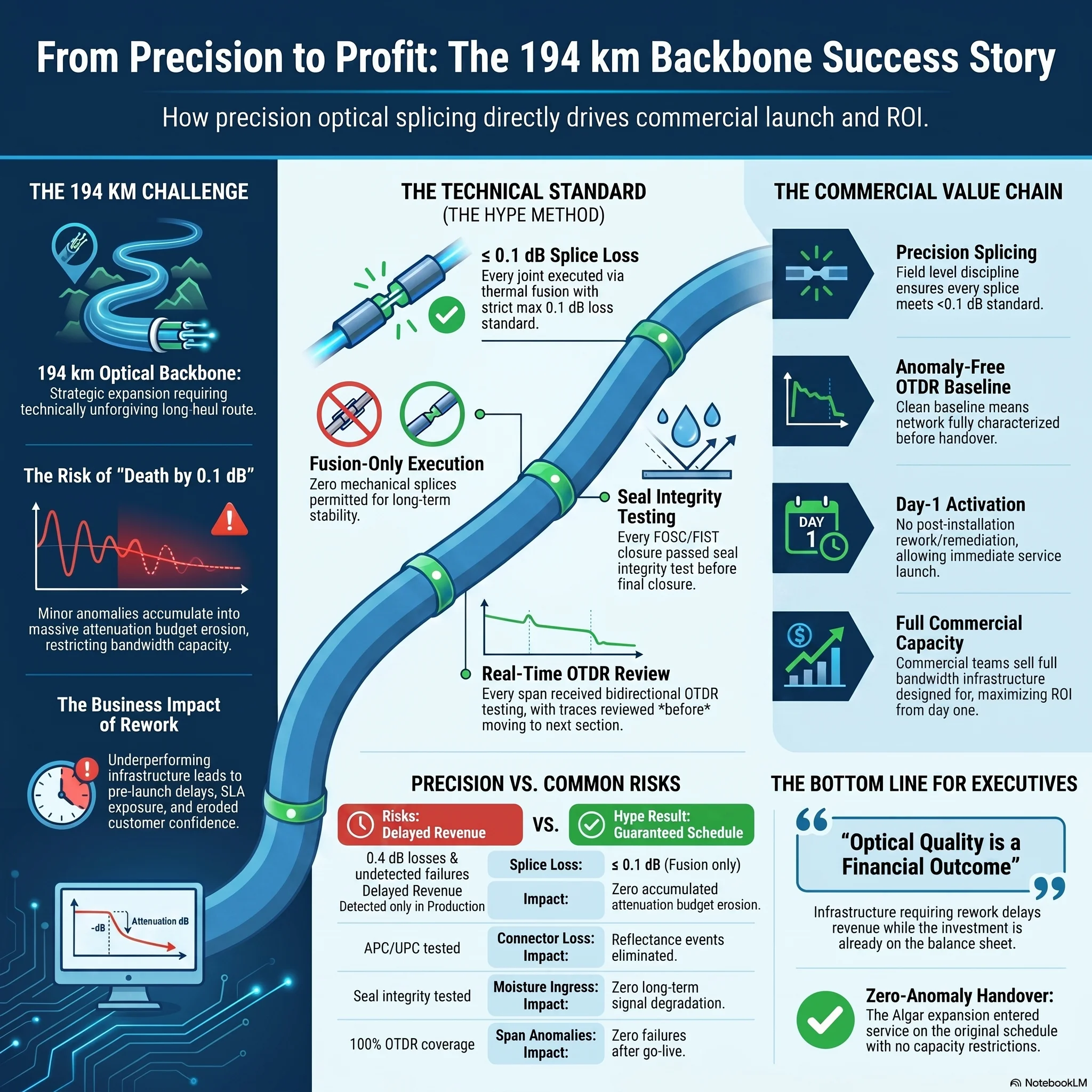
Long-haul backbone infrastructure at this scale is technically unforgiving. Over 194 kilometers, every optical anomaly — every splice that comes in at 0.2 dB instead of 0.1 dB, every enclosure with a micro-bend, every connector with a contaminated end-face — compounds into attenuation budget erosion. The consequence is not a polite engineering note. It is a backbone that cannot support the highest-capacity services, that requires re-work before commercial launch, or that produces client-reported signal degradation after activation.
Any of those outcomes has a direct revenue impact. Re-work before launch delays the commercial activation date. Signal anomalies after activation create SLA exposure and erode client trust on a carrier’s most visible infrastructure. Capacity constraints on a new backbone limit the services that can be sold — which limits the revenue that justifies the infrastructure investment in the first place.
Algar’s requirement was therefore not simply “good splicing.” It was an optical commissioning process that delivered a backbone with a fully validated, zero-anomaly OTDR baseline across the entire 194km route — the kind of baseline that supports commercial activation on the first attempt, without revision.
Why Hype Telecom
Hype Telecom was selected as Algar’s credentialed contractor under the MARE framework (Manual de Redes — Algar’s internal technical standard for network construction and maintenance). This accreditation is not a commercial arrangement. It is a technical qualification: it means Hype Telecom’s splicing practices, equipment standards, and documentation outputs have been validated against Algar’s own specifications before the contract begins.
Under the MARE standard, fusion splicing is the only permitted method for backbone joints. Mechanical splices are prohibited. Every fusion must be delivered within the 0.1 dB standard. Every enclosure — FOSC or FIST, depending on the fiber count — must pass a watertightness test before final closure. Every link must be OTDR-tested bidirectionally, with traces recorded and submitted as part of the delivery documentation. These are not Hype Telecom’s internal quality targets. They are the baseline that the client requires — and that Hype Telecom consistently delivers.
What differentiates the execution at scale is not meeting the standard on a single splice or a single link. It is maintaining the standard uniformly across hundreds of fusion points over 194 kilometers. That requires process discipline in the field: each splice team following the same preparation protocol, each enclosure receiving the same sealing procedure, each OTDR trace reviewed before the crew moves to the next span rather than deferred to a post-project review that finds problems after the infrastructure is already partially buried.
The Optical Quality → Revenue Chain
How precision splicing on a 194km backbone translated directly into measurable commercial outcomes for Algar Telecom.
- ≤0.1 dB per fusion
- Fusion-only — no mechanical splices
- Watertight enclosures
- Pre-burial OTDR review
- Bidirectional OTDR per fiber, per link
- 194km validated before activation
- No re-work
- No signal anomaly delays
- Full capacity available for commercial sales
- Algar's served market revenue growth following backbone activation
- ≤0.1 dB per fusion
- Fusion-only — no mechanical splices
- Watertight enclosures
- Pre-burial OTDR review
- Bidirectional OTDR per fiber, per link
- 194km validated before activation
- No re-work
- No signal anomaly delays
- Full capacity available for commercial sales
- Algar's served market revenue growth following backbone activation
What Hype Telecom Delivers
On the Algar backbone, Hype Telecom delivered the complete optical splicing and commissioning scope across the 194km route. The work encompassed all stages of the fusion process: cable preparation, tube loose sangria and organization in splice tray bandejas, fusion execution, mechanical protection, enclosure assembly and sealing, and final OTDR validation.
Enclosures were installed in compliance with Algar’s homologated standards — FOSC-type for routes up to 72 fibers, FIST-type for higher-count cables. Each enclosure passed a watertightness test before final closure. Capacity addition (CapAdd) points along the route were configured with derivation-ready joints, enabling future cable insertions without re-opening the backbone.
The OTDR testing program covered every fiber on every link in both directions — at 1310nm and 1550nm — with traces analyzed before the crew advanced to the next span. Events equal to or greater than 0.1 dB were identified, root-caused, and resolved in the field before the link was accepted. The delivery documentation included the complete set of OTDR traces, splice loss records, and test reports, submitted as a structured digital package aligned with Algar’s project management requirements.
Signal Budget Control — Source by Source
Every source of optical loss across the 194km route, and how each one was systematically controlled.
| Loss Source | Hype Telecom Result | Impact on 194km Backbone |
|---|---|---|
| Splice loss (fusion) | ≤ 0.1 dB per splice (MARE/Algar standard) | No accumulated attenuation budget erosion across long-haul spans |
| Connector / termination loss | APC/UPC connectors tested before insertion | Reflectance events eliminated before activation |
| Macro-bend loss (cable routing) | Minimum bend radius enforced at every enclosure | No routing-induced signal loss at enclosure or box level |
| Moisture ingress (enclosure) | Watertightness test on every FOSC/FIST before closure | Zero enclosure-level degradation over time |
| Link-level anomalies | Bidirectional OTDR at 1310nm and 1550nm per fiber | Every event ≥ 0.1 dB identified and resolved before handover |
| Undetected faults | 100% OTDR trace coverage before activation | Zero client-reported signal faults post-go-live |
Execution Highlights
- MARE-accredited contractor: Hype Telecom operates as a qualified contractor under Algar’s internal network standard (MARE V5), meaning technical standards are pre-validated before field mobilization, not negotiated per-project.
- Fusion-only backbone: zero mechanical splices on the 194km route — every joint executed by thermal fusion in compliance with MARE prohibitions on mechanical connection in backbone infrastructure.
- Pre-burial OTDR review: every link reviewed before advancing to the next span; anomalies resolved in the field, not discovered in a post-project audit.
- Bidirectional testing at 1310nm and 1550nm: complete fiber characterization across the full route, producing a baseline that supports both current service activation and future high-capacity wavelength provisioning.
- Watertight enclosures, 100% tested: every FOSC and FIST enclosure passed a stagnation (watertightness) test before final closure — eliminating the most common source of long-term signal degradation in aerial and underground backbone.
- CapAdd-ready joint configuration: derivation-capable splice points installed at pre-planned intervals, enabling future capacity additions without re-opening sealed backbone spans.
- Structured digital delivery package: complete OTDR trace archive, splice loss log, test report, and as-built documentation submitted in Algar’s required format — no rework of documentation after project close.
- Zero signal anomalies at handover: the 194km backbone activated with a clean OTDR baseline — no signal events requiring post-activation investigation or service-affecting intervention.
What Precision Splicing Prevents
Seven failure modes that precision splicing systematically eliminates — compared against what happens without it.
| Without Precision Splicing | Hype Telecom — Precision Splicing |
|---|---|
| Splice loss varies between 0.1 and 0.4 dB per fusion | Every splice certified at ≤ 0.1 dB — MARE/Algar standard |
| Signal degradation accumulates across 194km | OTDR validation per link — no loss accumulation undetected |
| Mechanical splices used where fusion is difficult | Fusion splicing mandatory — no mechanical splices on the backbone |
| Splice enclosures installed without stagnation test | Watertightness test on every FOSC/FIST enclosure before closure |
| Test reports produced at project end | Bidirectional OTDR traces recorded per fiber, per link, per span |
| Failures discovered by clients during service delivery | Zero anomaly OTDR baseline — faults found before activation |
| Re-work required on underperforming links | 100% of links meet signal budget before handover — zero re-work |
The Business Result
The commercial outcome of this program is the most direct evidence available that optical infrastructure quality has measurable revenue consequences.
Algar’s 194km backbone expansion was a strategic investment in commercial reach. The revenue growth it was designed to generate required one condition that is entirely outside the sales and marketing function: the infrastructure had to work, at full capacity, from the first day of commercial availability.
That condition was met. The backbone activated without revision, without signal anomalies, and without the capacity constraints that would have limited the services available for sale. Algar’s commercial teams entered the market with the full bandwidth that the infrastructure was designed to carry. The result was 25% revenue growth in the served market in the period following activation — a commercial return that would not have been achievable against an infrastructure baseline that required re-work or produced post-activation signal events.
The cost of poor splicing at scale is not hypothetical. It is the re-work bill before activation, plus the SLA penalties during investigation, plus the client attrition from services that don’t perform to specification, plus the delay to commercial launch while the team resolves what should have been resolved before the cable went in the ground. Each of those costs is larger than the cost difference between a precision optical contractor and a cheaper alternative.
BUSINESS OUTCOME:
Algar Telecom achieved 25% revenue growth in the served market following activation of the 194km backbone. The infrastructure activated with a zero-anomaly OTDR baseline and no signal events requiring post-launch investigation — allowing commercial operations to begin at full capacity on Day 1.
What This Means for CTOs and COOs
For a CTO or COO evaluating infrastructure investment decisions, the connection between optical quality and financial outcomes often gets lost in translation between the engineering team and the business case. The engineering team reports attenuation and OTDR results. The business case reports projected revenue. The link between the two is rarely made explicit.
This engagement makes it explicit. The mechanism is straightforward: infrastructure that activates with a clean signal baseline enables commercial operations to begin at full capacity on Day 1. Commercial operations at full capacity on Day 1 generate the revenue the infrastructure was built to carry. Infrastructure that requires post-activation re-work delays that revenue — while the investment is already on the balance sheet.
The practical implication for infrastructure leaders evaluating optical contractors is therefore not simply technical. It is financial. The question is not “which contractor can splice fiber.” The question is “which contractor can activate a 194km backbone with a zero-anomaly OTDR baseline on the first attempt, so that the commercial case for the infrastructure is not eroded before the first service is sold.”
Hype Telecom’s MARE accreditation with Algar Telecom — and the optical performance record it reflects — provides a verifiable answer to that question for any organization planning backbone infrastructure in Brazil.
FAQ
Complete optical splicing and commissioning across the full 194km route: cable preparation, tube loose sangria and splice tray organization, thermal fusion execution, mechanical protection, FOSC/FIST enclosure assembly and watertightness testing, and bidirectional OTDR validation at 1310nm and 1550nm per fiber per link. Deliverables included the full OTDR trace archive, splice loss records, test reports, and structured digital documentation package.
Under the MARE (Manual de Redes) framework — Algar Telecom’s internal technical standard for network construction — fusion splicing is mandatory and mechanical splices are prohibited on backbone infrastructure. The maximum permitted splice loss is 0.1 dB per fusion. Every enclosure must pass a watertightness test before closure. Every link must receive bidirectional OTDR validation before handover. Hype Telecom operates as a MARE-credentialed contractor, meaning these standards are pre-qualified, not negotiated per project.
Through process discipline at the field level: each fusion team follows the same preparation protocol for every joint, each enclosure receives the same sealing procedure, and each OTDR trace is reviewed before the crew advances to the next span. Events ≥ 0.1 dB are root-caused and resolved in the field — not deferred to a post-project audit that finds problems after the infrastructure is partially buried. The result is a uniform quality standard across every span, not just the ones that received supervisory attention.
Algar’s 25% revenue growth in the served market was enabled by a backbone that activated at full capacity on Day 1, with no signal anomalies requiring investigation or re-work. That activation quality was a direct function of the optical commissioning standard: zero splice loss events above 0.1 dB, 100% OTDR coverage before handover, and a zero-anomaly baseline that let Algar’s commercial teams sell into the full bandwidth of the new infrastructure from the first day of availability.
Yes. The standard delivery package for backbone commissioning includes: bidirectional OTDR traces per fiber (at 1310nm and 1550nm), splice loss log per joint, test report per link or enlace, watertightness test records per enclosure, and an as-built documentation set. All materials are submitted in the client’s required format — Algar’s MARE documentation standard in this case — as a structured digital archive.
Yes. CapAdd activities — inserting additional cables into existing splice enclosures, adding derivation joints, and re-qualifying the optical path after each addition with VFL and OTDR — are part of the standard service scope. Hype Telecom configures new backbone spans with derivation-capable joints at pre-planned intervals, enabling future CapAdd without re-opening sealed backbone sections.
Hype Telecom delivers precision optical splicing and backbone commissioning for carriers and infrastructure operators in Brazil, with OTDR-validated zero-anomaly handover on every project. If your infrastructure timeline depends on a backbone that activates clean, it may be time to work with a contractor whose quality standard is defined by the client’s own technical specification.
No obligation. We review your route, fiber count, signal budget requirements, and activation timeline and recommend the right commissioning model for your infrastructure.