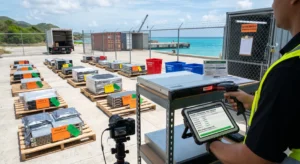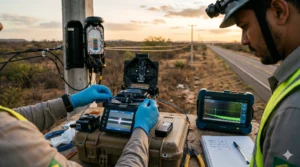
Zero Data Exposure. Zero Landfill Routing. Full Compliance Audit Trail — Across Three Jurisdictions.
When a global hyperscaler needed to decommission infrastructure across a multi-site Caribbean deployment — spanning U.S. mainland sites, Puerto Rico, and the U.S. Virgin Islands — the compliance requirements were not additive. They were multiplicative: each jurisdiction added its own data eradication documentation layer, its own environmental disposal framework, and its own logistics constraints for moving hardware off an island and into a certified disposition stream.
Hype Telecom was engaged to execute the end-to-end decommissioning scope: physical de-racking, asset inventory and serial number capture, data eradication with Certificate of Destruction (CoD) issuance per device, and routing of retired hardware through the client’s tiered disposition hierarchy — re-sell where value exists, certified recycling where it does not, donation where the asset has remaining useful life, and destruction with CoD where data security requires it. The result: 100% ERAD compliance across all sites, zero untracked assets, and a complete chain-of-custody documentation package delivered to the client’s compliance team before the last site closed.
The Challenge
Decommissioning infrastructure in a single mainland data center is a logistics and documentation exercise. Decommissioning infrastructure across three jurisdictions — including two island territories with their own environmental regulators, their own data privacy layers, and their own physical constraints on hardware removal — is a compliance program.
The core operational challenge of Caribbean infrastructure decommissioning is one that rarely appears in mainland SOW templates: getting hardware off an island. Puerto Rico and the U.S. Virgin Islands are U.S. territories, which means customs is not a barrier. But island logistics introduce constraints that mainland projects do not face: limited consolidation capacity at port-side facilities, restricted freight windows, and the absence of the dense network of certified ITAD processors that exists in major U.S. metro markets. An asset that can be routed to a certified recycler in Dallas within 48 hours might require a three-week consolidation-and-shipping cycle from St. Croix.
The compliance challenge compounds the logistics one. Each jurisdiction adds documentation requirements above the client’s own ERAD standard: Puerto Rico’s local data privacy framework requires specific manifest documentation that differs from the mainland chain-of-custody format. The U.S. Virgin Islands Department of Planning and Natural Resources (DPNR) has its own environmental disposal requirements for e-waste that add a layer above the federal EPA baseline. Managing these requirements in isolation — as separate sub-contractors handling each territory — creates handoff risk at exactly the point where compliance exposure is highest.
There was also the data exposure dimension. For the hyperscaler client, a single untracked asset — one device that leaves a site without a serial number log, a data eradication record, and a CoD — is not an operational inconvenience. It is a potential compliance breach that triggers internal escalation, client notification obligations, and reputational exposure. The standard the client required was 100% ERAD compliance, measured against the complete asset inventory captured at decommission start.
Why Hype Telecom
Hype Telecom was selected because the engagement required a partner capable of managing physical decommissioning, documentation compliance, and multi-jurisdiction logistics under a single coordinated model — with a named Project Manager as the sole point of contact for the client’s compliance team throughout the program.
What Hype Telecom brought to this program was the combination of field execution capability and compliance process discipline that cross-border decommissioning requires. The field teams operating in Puerto Rico and the U.S. Virgin Islands were not ad-hoc dispatch: they were named technicians operating under the same ITAD procedure, the same serial number capture protocol, the same photo documentation standard, and the same CoD issuance process used at mainland sites — with the additional jurisdiction-specific documentation layers applied on top, not as an afterthought.
The reverse logistics model was designed before the first rack was touched. Consolidation points were identified in both island territories for hardware staging prior to mainland routing. Certified ITAD processors were pre-qualified in each geography. The disposition hierarchy — re-sell, recycle, donate, destroy with CoD — was documented and agreed with the client before mobilization, so that every asset moved through a pre-approved channel with a pre-defined documentation trail.
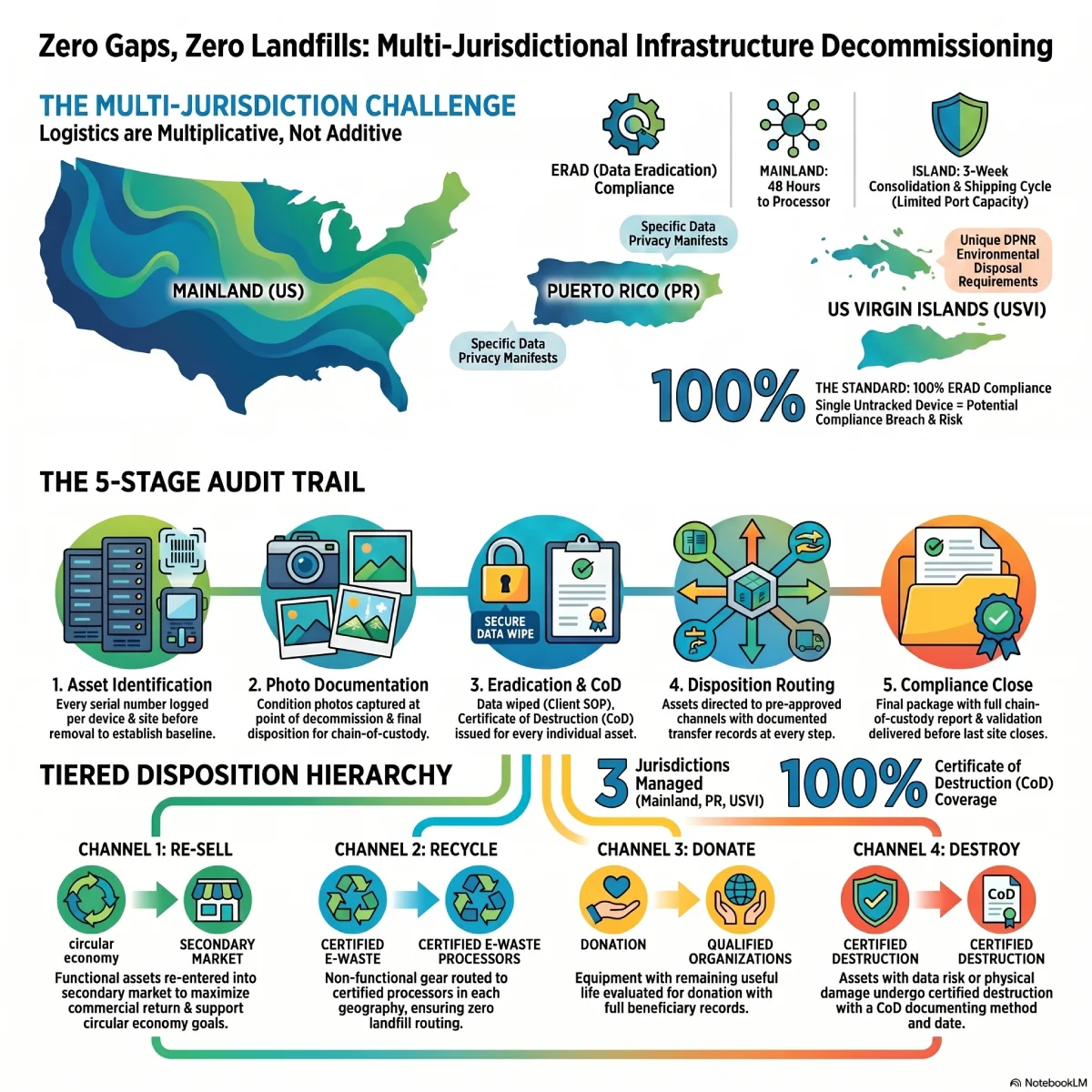
The Disposition Hierarchy — What Happens to Every Asset
Not every decommissioned asset is a candidate for destruction. Hype Telecom executes the client's tiered disposition framework, routing each asset to the channel that maximizes environmental and commercial value while maintaining full compliance documentation at every step.
What Hype Telecom Delivers
The decommissioning scope executed by Hype Telecom covered the full lifecycle of every asset from site to compliance close. The work began with pre-decommission audit: validating the client’s asset management system data against items physically present in the field, identifying discrepancies before any hardware was removed, and establishing the baseline inventory against which 100% ERAD compliance would be measured.
Physical decommissioning followed the audit: de-racking equipment, performing serial number capture and condition photography per device, disconnecting and labeling cables, and preparing hardware for staged removal. In island territories, this included staging assets at a consolidated holding point pending freight scheduling — a step that mainland projects rarely require but that island programs cannot skip without creating a chain-of-custody gap.
Data eradication was executed per the client’s ERAD procedure, with CoD documentation generated per device and cross-referenced to the serial number log. Where assets were routed to recycling or donation, documentation was generated at the point of transfer. Where assets were routed to destruction, the CoD included method, date, supervising technician, and client reference number.
Reverse logistics coordination ran throughout the program: routing functional assets toward re-sell assessment, coordinating with certified recyclers in each geography for non-functional equipment, and managing the freight cycle from island consolidation points to mainland processing facilities. The client received weekly inventory and consumption reports during the active decommission phase and a final compliance package at project close.
The Audit Trail — From De-Rack to Compliance Close
Every asset that enters the decommissioning stream generates a continuous documentation record. The five-stage audit trail below reflects the process applied uniformly across all sites and jurisdictions.
Cross-Border Compliance — Three Jurisdictions, One Framework
The table below maps the compliance dimensions of this program across the three jurisdictions covered. Each column reflects the requirements applied in addition to the client's own ERAD standard.
| Compliance Dimension | U.S. Mainland | Puerto Rico | U.S. Virgin Islands |
|---|---|---|---|
| Data Eradication Standard | Client ERAD procedure + CoD per asset | Client ERAD procedure + CoD per asset + PR local data privacy law | Client ERAD procedure + CoD per asset + USVI regulatory layer |
| Environmental Disposal | EPA + state e-waste regs | Puerto Rico EPA (PREPA) + EPA federal baseline | USVI DEP + EPA federal baseline |
| Export of Hardware | Interstate — no customs | U.S. territory — no customs. Domestic logistics rules apply | U.S. territory — no customs. Island logistics constraints apply |
| EHS Standards | OSHA 29 CFR + NFPA + local codes | OSHA 29 CFR + PR Labor Dept standards + local building codes | OSHA 29 CFR + USVI DPNR standards + local codes |
| Reverse Logistics | Centralized depot (lowest-cost routing) | Island consolidation point, then mainland routing | Island consolidation point, then mainland or PR routing |
| Audit Documentation | Serial # + photos + CoD + chain of custody | Serial # + photos + CoD + PR-specific manifest | Serial # + photos + CoD + USVI manifest |
Execution Highlights
- 100% ERAD compliance at program close: every asset inventoried at decommission start tracked through disposition with CoD or transfer documentation — zero untracked devices across all sites and jurisdictions.
- Pre-decommission audit per site: client asset management system data validated against physical field inventory before any hardware removal — discrepancies identified and resolved before the decommission clock started.
- Serial number capture and photo documentation at de-rack: every device photographed at condition assessment and logged by serial number before leaving the rack — establishing the chain-of-custody baseline that CoD documentation references.
- CoD issued per device, per jurisdiction: Certificate of Destruction generated for every asset undergoing eradication, with method, date, and jurisdiction-specific compliance reference included — structured for client compliance team review, not internal use only.
- Island logistics model pre-built before mobilization: consolidation points identified in Puerto Rico and the U.S. Virgin Islands before field teams mobilized — eliminating the improvised staging decisions that create chain-of-custody gaps on island programs.
- Tiered disposition execution: assets routed through the client’s re-sell / recycle / donate / destroy hierarchy with documentation at each transfer point — maximizing residual value capture and minimizing landfill routing in compliance with ESG commitments.
- Multi-jurisdiction EHS compliance: field operations in Puerto Rico (PREPA, PR Labor Department) and the U.S. Virgin Islands (DPNR) executed under jurisdiction-specific EHS plans, with Avetta pre-qualification maintained across all geographies.
- Named Project Manager as sole compliance contact: one point of contact for the client’s compliance team throughout the program — daily coordination, weekly inventory reports, and final compliance package delivery coordinated through a single escalation path.
- Reverse logistics to certified processors: all non-functional hardware routed to certified e-waste recyclers in the relevant geography — no landfill routing, no uncertified disposal, no gap between island removal and mainland processing documentation.
- Final compliance package delivered at project close: complete chain-of-custody record, ERAD log, CoD archive, photo documentation set, and disposition manifest submitted to client compliance team before the last site was cleared.
PROGRAM KPIs ACHIEVED:
ERAD compliance 100% (target: 100%) • Untracked assets at close: 0 (target: 0) • CoD issued per asset: 100% • Weekly inventory reports: delivered on schedule • Final compliance package: submitted before site clearance.
The Business Result
For the client’s compliance and sustainability teams, the outcome of this program was not simply that the sites were cleared. It was that the clearing generated a documented compliance record capable of withstanding regulatory review, internal audit, and client-facing scrutiny — across three jurisdictions, simultaneously.
The 100% ERAD compliance rate meant that the client’s data security obligations were met without exception. No device left any site without a documented eradication record or a disposition chain-of-custody. For an organization operating under enterprise data security frameworks, that outcome eliminates the compliance breach risk that a single undocumented device would trigger.
The tiered disposition model — re-sell, recycle, donate before destroy — aligned with the client’s ESG commitments by maximizing the circular economy value of retired hardware. Assets with remaining useful life were assessed for resale, reducing the demand signal for new hardware production. Non-functional assets were routed to certified recyclers, not landfills. The disposition record provides the ESG audit documentation that sustainability reporting requires.
From an operational perspective, the single-partner model eliminated the handoff risk that multi-vendor decommissioning programs create at jurisdictional boundaries. There was no gap between the mainland team’s documentation standard and the island team’s: one process, one PM, one compliance package.
What This Means for Compliance and Sustainability Leaders
For a Compliance Officer or Sustainability Director evaluating an infrastructure decommissioning program, the critical question is not whether the hardware will be removed. The hardware will be removed. The question is whether every device will have a documented trail from de-rack to final disposition — and whether that trail will hold up under audit conditions in every jurisdiction where the program operates.
Caribbean and island-territory decommissioning programs create compliance exposure at exactly the point where documentation discipline is hardest to maintain: remote sites, complex logistics, and jurisdiction-specific requirements that differ from the frameworks the compliance team is accustomed to reviewing. The instinct to treat island sites as logistically complex versions of mainland sites — rather than as distinct compliance environments — is the instinct that produces documentation gaps.
What this engagement demonstrates is a decommissioning model that treats compliance documentation as a field deliverable, not a back-office activity. Serial numbers are captured at de-rack, not reconstructed from asset management records afterward. CoDs are issued at eradication, not assembled from field notes two weeks later. The chain of custody is continuous — because the documentation process is embedded in the field execution, not appended to it.
For organizations planning decommissioning programs that cross jurisdictional boundaries — whether in the Caribbean, Latin America, or any multi-regulatory environment — the practical implication is clear: the compliance outcome is determined by the field execution model, not by the compliance team’s review process. A thorough post-project audit cannot recover documentation that was never generated. Hype Telecom generates it in the field, on the day it happens.
FAQ
Pre-decommission audit (field validation of asset management data), physical de-racking, serial number capture and condition photography per device, data eradication per the client’s ERAD procedure, Certificate of Destruction (CoD) issuance per asset, tiered disposition routing (re-sell / recycle / donate / destroy), island consolidation and reverse logistics coordination, multi-jurisdiction EHS compliance, weekly inventory and consumption reporting, and final compliance package delivery at program close.
A CoD is a formal document certifying that a specific asset — identified by serial number — has undergone data eradication by a defined method on a defined date, executed by a qualified technician. It is the compliance-grade record that proves an asset no longer poses a data exposure risk. On this program, CoDs were issued per device, cross-referenced to the serial number log, and included in the final compliance package delivered to the client’s compliance team.
Island decommissioning programs require a pre-built logistics model before field mobilization begins. For this program, Hype Telecom identified consolidation points in Puerto Rico and the U.S. Virgin Islands for hardware staging prior to mainland routing, coordinated freight schedules to minimize the gap between physical removal and certified disposition, and maintained chain-of-custody documentation throughout the shipping and transfer process. Certified ITAD processors were pre-qualified in each geography before the program started.
Both territories are subject to the federal EPA baseline for e-waste disposal, with jurisdiction-specific layers above it: Puerto Rico operates under the Puerto Rico Environmental Quality Board (PREPA) framework, and the U.S. Virgin Islands operates under the USVI Department of Planning and Natural Resources (DPNR). Hype Telecom’s field operations in each territory maintained compliance with both the federal baseline and the applicable territorial environmental standards, with all recycling routes going to certified processors.
Yes. The ITAD/ERAD model — including CoD issuance, tiered disposition, reverse logistics coordination, and weekly reporting — is designed for both project-based and recurring programs. For clients with ongoing hardware refresh cycles or distributed infrastructure that requires periodic decommissioning across multiple jurisdictions, Hype Telecom can operate as a standing ITAD partner under a recurring service model with defined reporting cadences and pre-approved disposition channels.
The re-sell > recycle > donate > destroy hierarchy is designed to maximize the circular economy value of retired hardware before destruction. Assets routed to resale reduce the market demand for new production. Assets routed to certified recycling are processed without landfill contribution. Donation assets reach qualified organizations with documentation for ESG reporting. At every step, a transfer document is generated — providing the asset-level disposition evidence that sustainability auditors and ESG reporting frameworks require.
Hype Telecom delivers sustainable, certified ITAD and decommissioning services across the Americas — with a field execution model that generates the compliance documentation at the point of work, not after the fact. If your program involves island logistics, multi-jurisdiction EHS requirements, or 100% ERAD compliance targets that cannot afford a single undocumented asset, it may be time to work with a partner whose field process is built around the audit trail.
No obligation. We review your site count, jurisdictions, asset volume, data eradication requirements, and disposition preferences and propose the right program structure for your compliance and sustainability objectives.