How Hype Telecom Delivers Hyperscale Rack & Stack Across the Americas
Deploying at Hyperscale Speed — Multiple Sites, One Compressed Timeline, On Track or Ahead
When the deployment window is tight and the number of sites spans an entire region, execution discipline becomes the only variable that actually matters. Hype Telecom was engaged to deliver a multi-site Rack & Stack program across the Americas under an aggressive phased schedule. The result was consistent across every location: installations completed to specification, validated, documented, and handed over — on or ahead of the projected timeline.
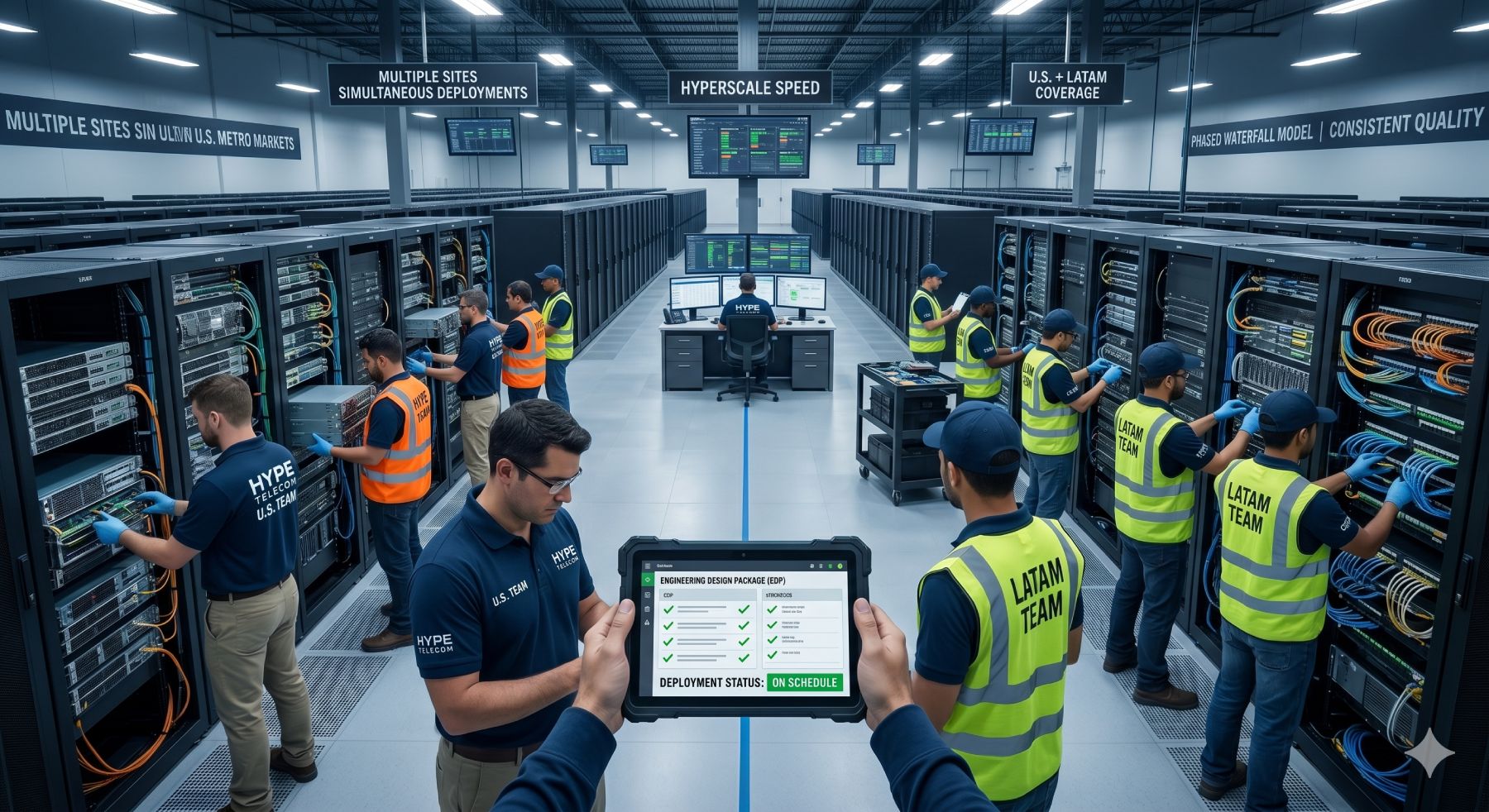
| Multi-Site simultaneous deployments across the Americas | Delivered on or ahead of schedule across program phases | U.S. + LATAM field coverage with a single coordinated team |
The Challenge
Hyperscale infrastructure buildouts don’t fail because of bad intentions. They fail because of coordination gaps: equipment that arrives before the team, teams that arrive before the design package, sites with inconsistent readiness, and handoffs that break the execution rhythm built at the first location.
For large-scale Rack & Stack programs across multiple metro locations, the challenge is never simply physical. Any director of operations who has run a distributed infrastructure deployment knows that the hard part isn’t installing a server or dressing a cable — it’s keeping the same quality standard at location twelve that was achieved at location one, in a different building, with a different local crew, under a tighter remaining schedule.
The program that Hype Telecom was brought in to support carried exactly that profile. Multiple deployment sites distributed across U.S. metro markets, with phased timelines that compressed as the program advanced and a client whose infrastructure roadmap depended on sites going live on or before the committed dates. Any site running late would cascade.
Why Hype Telecom
Hype Telecom was selected because the engagement required more than field labor. It required a partner capable of ingesting an Engineering Design Package (EDP), deploying against it without drift, and producing consistent documentation output — deployment checklists, quality records, serial number logs, as-built photos — regardless of which site was being executed on any given day.
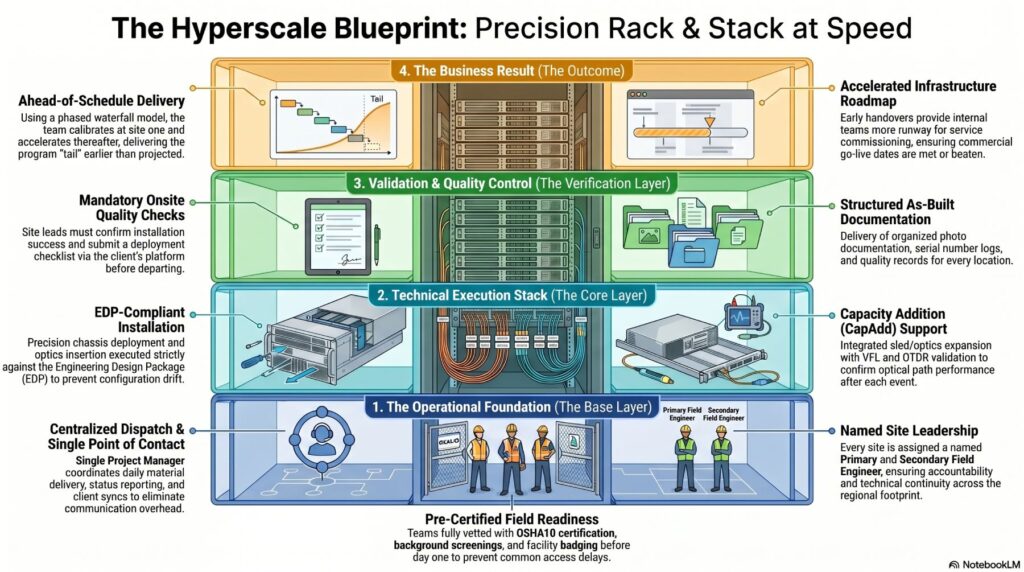
What differentiated Hype Telecom in this context was the model behind the technicians. Named, qualified field engineers were placed at each site as primary and secondary leads. Dispatch was centralized through a single Project Manager who served as the sole point of contact for the client, coordinating daily delivery of materials, daily status reporting, and weekly sync meetings with the client stakeholder team — without creating additional communication overhead on the client side.
The field team also met every background screening, safety certification, and access requirement the program demanded — including OSHA10 certification, drug screening protocols, and badging processes at secured facilities. These requirements were addressed before the first deployment began, eliminating the most common source of day-one delays on enterprise infrastructure programs.
What Hype Telecom Delivers
Hype Telecom delivered end-to-end Rack & Stack and physical deployment services across all sites in scope. Each site followed the same structured execution sequence: equipment receiving and inventory verification, rack staging and chassis installation per EDP, insertion of pluggable optics, fiber optic jumper installation and termination, AC power cabling, CAT6 structured cabling, and full labeling of all components with Near End and Far End port identification aligned to the Engineering Design Package.
Every site received an onsite quality check before the team departed, with deployment checklist sign-off submitted directly to the client project manager via the client’s preferred coordination channel. As-built photo documentation was captured and delivered in a structured, organized format at each location.
Beyond the initial deployment, Hype Telecom also supported Capacity Addition (CapAdd) activities at sites that required it — inserting additional sleds and optics, adding fiber jumpers, and re-qualifying the optical path after each capacity event using VFL and OTDR validation to confirm continuity and splice performance.
Execution Highlights
- Named primary and secondary field engineers at every site, with centralized dispatch managed by a single Project Manager as sole client point of contact.
- Full pre-certification of field teams before program launch: OSHA10, background screening, and facility badging completed prior to mobilization, eliminating the most common source of day-one access delays.
- EDP-compliant installation at every site: chassis deployment, optics insertion, fiber jumper termination, power cabling, CAT6 cabling, and structured labeling executed to a uniform standard across all locations.
- Phased waterfall deployment model: first site used to calibrate pace, validate processes, and train leads before cascading the team to subsequent locations — compressing timeline without compressing quality.
- Deployment checklist, serial number log, and as-built photo documentation submitted per site before team departure.
- Capacity Addition (CapAdd) support integrated into the operating model, with VFL and OTDR qualification after each expansion event.
- Daily status reporting and weekly client sync meetings maintained throughout the program lifecycle, with escalation paths activated proactively, not reactively.
- Client communication managed through the client’s designated platform, with site leads required to confirm installation success before leaving each location.
The Business Result
The outcome of this program was not simply that all sites were deployed. The outcome was that the client’s infrastructure roadmap stayed on schedule — and in several phases, moved ahead of it.
By anchoring the first deployment site as a training and calibration event, Hype Telecom built a field team that gained pace at each subsequent location. The phased model originally designed to absorb schedule risk instead became a mechanism for protecting it. Later sites typically completed at or above the calibrated pace, and the tail of the program was delivered on or ahead of the original projected dates.
For the Director of Operations responsible for this program, that result carried real business value. Equipment went live on plan or earlier across the program. Internal teams gained additional runway to validate, configure, and commission services before commercial go-live. The schedule buffer built to absorb field delays was largely preserved — because the field delays the model is designed to prevent didn’t materialize at scale.
What This Means for Buyers
For Directors of Operations running distributed infrastructure deployments, the core risk is always the same: a field execution partner that performs well on the first site and degrades from there. Crew turnover, inconsistent training, documentation that gets lighter as the schedule gets tighter — these are the patterns that turn a 90-day program into a 130-day program.
What this engagement demonstrates is a different operating model. Hype Telecom’s execution didn’t degrade across sites — it accelerated, because the model was built around process replication rather than technician improvisation. Named engineers, centralized dispatch, EDP compliance, daily reporting, and a single point of contact created a structure where the quality at site twelve wasn’t dependent on whether the same technician who worked site one happened to be available. For organizations planning Rack & Stack programs across the Americas — whether single-country or cross-border — the practical implication is straightforward: execution discipline on multi-site programs isn’t a function of having enough people. It’s a function of having the right model behind those people. That’s what Hype Telecom provides.
FAQ
What does Hype Telecom’s Rack & Stack service include?
End-to-end physical deployment: equipment receiving and inventory check, chassis and device installation per EDP, pluggable optics insertion, fiber optic jumper installation and termination, AC power cabling, CAT6 cabling, structured labeling, onsite quality check, deployment checklist submission, as-built photo documentation, and Capacity Addition (CapAdd) support as required.
How does Hype Telecom manage quality consistency across multiple sites?
Through a structured model with named engineers at each location (primary and secondary), centralized dispatch via a dedicated Project Manager, EDP-compliant execution at every site, and mandatory deployment checklist sign-off before any team departs. The first site in any multi-site program also serves as a calibration and training event to set the standard before the team scales to subsequent locations.
Does Hype Telecom meet access and safety requirements for secured data center facilities?
Yes. Field teams are pre-certified before program launch, including OSHA10 certification, background screening, and facility-specific badging processes. Access requirements are addressed prior to the first deployment date, eliminating the most common day-one delays that enterprise programs typically absorb during mobilization.
What reporting and governance structure does Hype Telecom provide?
A single Project Manager serves as the sole point of contact for the client, coordinating daily status reporting, daily material delivery, weekly sync meetings with client stakeholder teams, and escalation management. Site leads are required to confirm successful installation through the client’s designated communication platform before leaving each location.
Can Hype Telecom support Capacity Addition activities after initial deployment?
Yes. CapAdd support — including insertion of sleds and optics, fiber jumper additions, and VFL/OTDR qualification of the optical path after each expansion event — is integrated into the operating model and can be executed as a continuation of the deployment engagement or as a standalone recurring service.
What geographies does Hype Telecom cover for Rack & Stack programs?
Across the United States, Hype Telecom fields 28+ active field engineers in 12 states, backed by an extended bench of 70+ qualified technicians. In Brazil, a local subsidiary delivers nationwide reach, supported by a track record of 1,581+ delivered projects and 800+ km of deployed fiber across 9 states. This dual presence supports multi-site programs across the Americas under a single coordinated model, eliminating the handoff risk and reporting inconsistency that come from working with separate providers in each market. LATAM operations are active; Portugal launches in Q3 2026.
Running a Rack & Stack program that needs to stay on — or ahead of — schedule?
Hype Telecom helps infrastructure and operations teams deploy physical equipment at scale across the Americas with consistent quality, centralized coordination, and the process discipline that multi-site programs actually require. If your current deployment model depends on ad-hoc dispatch, manual coordination, or technicians who are strong at the first site and uncertain at the fifth, it may be time for a different approach.
Outros Blogs