
5 Hidden Costs of Slow Data Center Deployment Costs (And How to Avoid Them)
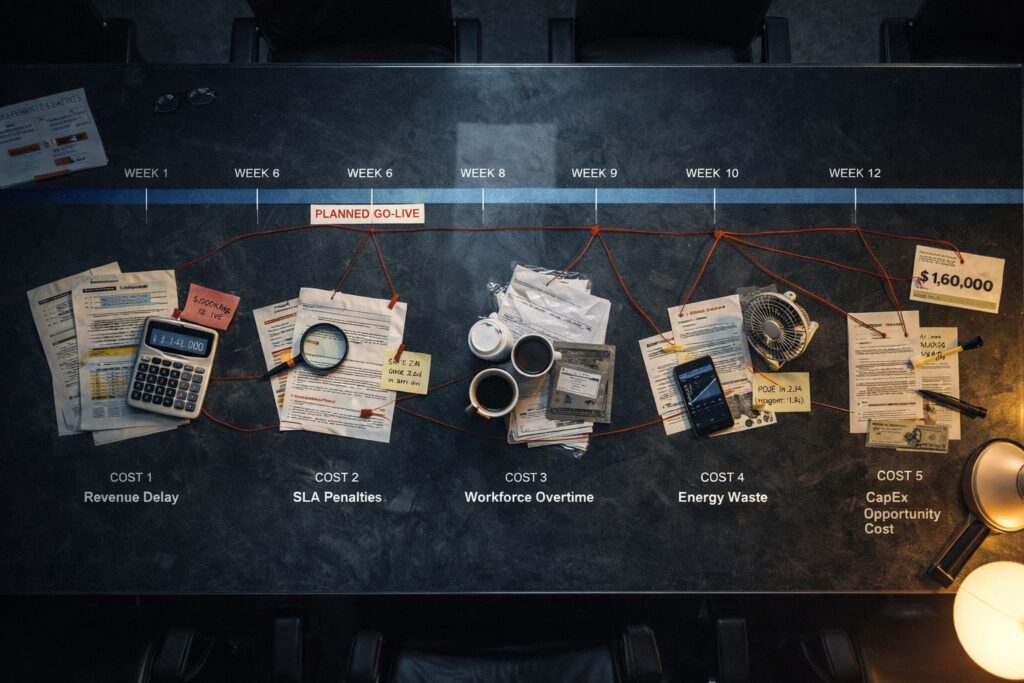
Every infrastructure leader knows what a deployment costs on paper: hardware, logistics, labor, and facility charges. However, when a deployment runs behind schedule — by days, weeks, or months — a second ledger opens. In reality, data center deployment costs extend far beyond the purchase order. They accumulate silently in missed revenue windows, SLA breach exposure, idle capital, staff escalations, and energy waste. As a result, for organizations running hyperscale deployment timelines, these hidden costs can dwarf the visible budget line. With this in mind, this article maps five specific cost categories that slow deployments generate, shows how each one compounds over time, and presents a practical framework for accelerating deployment without trading speed for quality. Whether you’re auditing a current project or scoping the next one, understanding the true cost profile is the first step to reducing it.

Why Deployment Speed Directly Affects Your Bottom Line
The assumption that deployment delay is primarily an IT operations problem — rather than a financial one — is itself a hidden cost. In fact, when infrastructure sits in a staging or partial-production state, it is consuming resources without generating returns. Consequently, the longer that state persists, the more the gap between planned and actual costs widens.
To illustrate, consider the compounding structure: a delayed go-live shifts revenue recognition. In turn, that shift affects cash flow, which affects the business case that justified the investment. If the deployment was tied to a customer SLA, delay creates penalty exposure. Similarly, if it was tied to a capacity expansion to serve demand, delay means revenue goes elsewhere — to a competitor or a workaround that itself carries cost.
Despite this, rack and stack optimization is often treated as a tactical execution concern, but it sits directly on the critical path of financial performance. In other words, every hour a rack sits staged but uncabled, every day a server sits racked but untested, represents a quantifiable cost that belongs in the project’s financial model — not just its Gantt chart.
Cost #1 — Revenue Loss from Delayed Go-Live
For any deployment tied to revenue-generating workloads — cloud tenants paying for capacity, SaaS platforms needing infrastructure to serve users, enterprises with committed launch dates — delayed time-to-production has a direct revenue cost. In essence, the calculation is straightforward: daily revenue attributable to the new infrastructure, multiplied by the number of days delayed. As a consequence, for hyperscale environments, this figure can reach six or seven digits quickly.
Furthermore, even when revenue impact is not immediate, delayed go-live creates downstream disruption: teams built around the new capacity operate at reduced efficiency, project dependencies shift, and delivery confidence erodes. Above all, the reputational cost with internal stakeholders is real even when it doesn’t appear in a spreadsheet.
Cost #2 — SLA Penalties and Contract Exposure
If your deployment is tied to a customer contract or a colocation SLA, timeline overruns create contractual exposure. SLA penalty structures in enterprise and hyperscale agreements often include daily or weekly financial remedies that accrue automatically. The cost is not hypothetical—it is a liability on the balance sheet from the moment the commitment was made.
Beyond direct penalties, SLA breaches damage renewal conversations, create negotiation leverage for the other party at contract renewal, and generate internal overhead from incident documentation, remediation planning, and stakeholder management. Preventing SLA exposure is one of the strongest financial arguments for investing in deployment acceleration.
The Operational Overhead Nobody Budgets For
Two more hidden costs live inside the deployment timeline itself: the people costs that multiply when timelines stretch, and the energy costs that accumulate during extended commissioning periods. Neither typically appears in the deployment budget. Both appear in the budget variance report after the fact.
Cost #3 — Staff Overtime and Contractor Escalation
Extended deployment timelines increase labor cost in two ways. First, internal teams absorb sustained deployment effort over a longer period — overtime pay, reduced availability for other projects, and burnout effects that show up in future productivity. Second, when timelines slip far enough, organizations often bring in external contractors or escalate to premium support rates to recover schedule, paying emergency premiums on work that should have been planned.
Moreover, in hyperscale environments, deployment teams are often shared resources covering multiple simultaneous projects. As a result, a slip in one deployment creates a cascading resource conflict that elevates cost across the portfolio. For this reason, rack and stack optimization — through pre-staging, standardized configurations, and resident on-site support — reduces the labor variability that generates these overruns.
Cost #4 — Energy Waste During Extended Deployment
Data center infrastructure consumes power from the moment it is energized—whether or not it is producing value. Servers running burn-in tests, cooling systems operating for partially populated rows, and lighting and facility systems active during extended commissioning periods all appear on the utility bill. For large deployments, PUE (Power Usage Effectiveness) during transitional phases is often significantly worse than steady-state PUE, meaning each kilowatt of overhead consumes proportionally more total facility power.
Extended deployment periods also create risk of equipment degradation during extended idle states, particularly in high-humidity or high-variation environments. The energy cost of a deployment that runs four weeks over schedule is not a trivial line item—especially at hyperscale power consumption rates.
Cost #5 — Opportunity Cost of Idle CapEx
Of the five hidden data center deployment costs, opportunity cost is the hardest to quantify and the most frequently ignored. When capital expenditure has been committed—hardware purchased, facility space allocated, contracts signed—every day that infrastructure is not in production is a day the organization is carrying full CapEx without generating return.
The opportunity cost question is: what else could that capital be doing? In a business where infrastructure investment competes with other growth initiatives, the cost of delayed deployment is not zero—it is the return on the next best use of that capital, foregone. For organizations with cost-of-capital models or internal hurdle rates, this is a calculable figure.
For hyperscale operators specifically, idle capacity during extended deployment timelines has an additional dimension: it affects ability to onboard new tenants, respond to demand signals, and maintain competitive positioning in markets where capacity availability is a product differentiator.
| Hidden Cost | Visibility | Onset Timing | Primary Driver | Mitigation Lever |
| Revenue loss from delayed go-live | Low | Day 1 of delay | Timeline overrun | Pre-staging + milestone SLAs |
| SLA penalties & contract exposure | Medium | At SLA breach date | Contractual commitments | Aggressive deployment SLA design |
| Staff overtime & contractor escalation | Low | Week 2–3 of overrun | Resource conflicts | Rack and stack optimization |
| Energy waste during deployment | Very Low | Day 1 of energization | PUE inefficiency | Phased commissioning |
| Opportunity cost of idle CapEx | Very Low | Day 1 of commitment | Capital not productive | Deployment timeline compression |
What Optimized Deployment Actually Looks Like
Reducing data center deployment costs is not about cutting corners — on the contrary, it is about removing the unplanned variability that creates cost overruns. In practice, optimized deployment has a distinct operational signature: standardized hardware configurations that reduce on-site decision-making, pre-staged racks that arrive cable-ready for installation, resident certified technicians who execute without waiting for remote authorization, and milestone-based SLAs that make schedule accountability contractual rather than aspirational.
Specifically, organizations that achieve significant hyperscale deployment timeline compression — routinely cited as 30–50% reductions in deployment cycle time — do so by front-loading work: configurations decided before equipment ships, cabling plans finalized before racks arrive, change management processes integrated into the deployment workflow rather than bolted on afterward.
Equally important, the role of on-site smart hands and FLM (First Line Maintenance) services in this model is critical. When certified technicians are resident rather than dispatched, the authorization latency that inflates deployment timelines disappears. In short, rack and stack optimization at scale requires not just process discipline but the right humans executing it — consistently, across every row, every shift.
Data Center Deployment Costs Audit Framework: Where Is Your Timeline Leaking?
Use this checklist to identify where your current or upcoming deployment is most exposed to hidden costs.
Score each item: 0 = Not addressed | 1 = Partially addressed | 2 = Fully addressed
- Revenue model: Have you calculated the per-day revenue cost of a deployment delay for this project?
- SLA mapping: Are all contractual SLA milestones documented with financial penalty clauses?
- Pre-staging: Are hardware configurations finalized and rack pre-staging scheduled before site arrival?
- On-site coverage: Do you have resident or rapid-response certified technicians for the deployment window?
- Energy phasing: Is the commissioning plan phased to minimize idle infrastructure runtime?
- CapEx productivity: Is there a defined go-live date tied to capital authorization for this deployment?
- Staff model: Is deployment labor planned and contracted, or reactive (overtime/contractor escalation)?
- Change management: Is a formal change management process integrated into the deployment workflow?
Score 0–6: High hidden cost exposure. Recommend deployment readiness review before proceeding.
Score 7–11: Moderate exposure. Target 2–3 specific gaps for immediate process improvement.
Score 12–16: Low exposure. Deployment is well-structured; focus on ongoing optimization.
Common Pitfalls When Choosing On-Site Data Center Support
Treating deployment as a one-time project, not a repeatable process. One of the largest drivers of data center deployment costs is inconsistency. Organizations that deploy infrastructure reactively—standing up new teams, rediscovering configuration decisions, rebuilding playbooks—pay a premium every cycle. Deployment acceleration compounds with standardization: the second optimized deployment is cheaper than the first.
Assuming that faster deployment means cutting quality steps. Speed and quality are not in tension in a well-engineered deployment process—they are the same thing. Rework, re-cabling, and configuration corrections are the largest sources of both delay and cost. Pre-staging and standardized rack design eliminate the root causes of rework, not the quality gates.
Underestimating hyperscale deployment timeline complexity. At scale, deployment is a coordination problem as much as a technical one. Multi-vendor hardware, parallel row deployments, change management across dozens of technicians, and integration with live facility operations create coordination overhead that doesn’t scale linearly. Organizations that apply SMB-style deployment processes to hyperscale projects systematically underestimate this complexity.
Not quantifying hidden costs before the project. The five costs described in this article are preventable—but only if they are identified and modeled before the project starts. Organizations that build deployment cost models exclusively around visible line items will consistently underestimate true project cost and overspend on recovery.
Best Practices: Compressing Deployment Timeline Without Compromising Quality
Standardize hardware configurations at the design phase. Every variation in server configuration, cable length, or rack layout is a decision that will be re-made on the floor during deployment. Standardization front-loads those decisions where they cost nothing to resolve, eliminating the on-site decision latency that inflates deployment labor hours.
Implement pre-staging as a default, not an option. Pre-staging—configuring and testing hardware before it arrives at the production facility—is one of the highest-ROI investments in deployment acceleration. It compresses on-site deployment time, reduces facility access requirements, and eliminates the discovery of configuration issues after the equipment is racked.
Contract for resident on-site support during deployment windows. On-demand technician dispatch is incompatible with compressed deployment timelines. Resident certified engineers operating under deployment SLAs—rather than ticket-based remote dispatch—eliminate the latency that compounds across hundreds of installation tasks in a hyperscale deployment.
Build financial accountability into the deployment SLA. Milestone-based deployment SLAs with financial consequences for overruns align incentives between operators and service providers. If the cost of a delay is measured, it is managed.
Integrate change management from day one. Deployment projects that treat change management as a phase-end checkbox rather than a continuous process consistently overrun. Integrating change management—approvals, documentation, rollback procedures—into the deployment workflow prevents the stop-start patterns that inflate both timeline and cost.
Conclusion
The five hidden data center deployment costs—revenue loss, SLA penalties, staff overtime, energy waste, and idle CapEx—share a common root cause: unplanned variability in the deployment process. Each is invisible in the initial project budget and highly visible in the post-project variance report.
The good news is that all five are addressable with the same set of interventions: standardized design, pre-staging, resident on-site support, milestone-based SLAs, and integrated change management. Organizations that build these into their deployment model don’t just reduce cost—they create a repeatable capability that compounds with every subsequent project.
For infrastructure leaders managing hyperscale deployment timelines, the question is not whether slow deployment has a cost. The question is whether that cost is being measured, modeled, and managed—or discovered after the fact.
Frequently Asked Questions
What are the most common hidden costs in data center deployments?
The five most common hidden costs are: revenue loss from delayed go-live, SLA penalty exposure during timeline overruns, staff overtime and contractor escalation when schedules slip, energy waste from idle or partially-loaded infrastructure during extended commissioning, and opportunity cost from CapEx committed but not yet producing returns. Most deployment budgets capture only direct costs — hardware, labor, logistics — and miss all five.
How do I calculate the revenue cost of a deployment delay?
Identify the daily revenue attributable to the workloads the new infrastructure will support. Multiply by the number of days between planned and actual go-live. For workloads that aren’t directly revenue-generating, calculate the operational cost of the workaround or alternative infrastructure in use during the delay. For hyperscale deployments, add the cost of any SLA penalties triggered by the delay.
What is rack and stack optimization and how does it reduce deployment costs?
Rack and stack optimization refers to the design, configuration, and execution practices that minimize on-site assembly and installation time. It includes standardized rack layouts, pre-configured hardware (ideally pre-staged off-site), structured cabling pre-cut to length, and certified on-site technicians who execute consistently without requiring real-time remote authorization. Optimization reduces labor hours, rework rates, and the timeline variability that generates hidden costs.
What is a realistic hyperscale deployment timeline, and what affects it most?
A hyperscale deployment timeline varies significantly based on environment complexity, hardware volume, and pre-staging maturity. Organizations without optimization typically see 8–16 weeks for a large-scale deployment. With standardized configurations, pre-staging, and resident on-site support, that timeline can compress to 4–8 weeks. The single largest variable is decision latency — the time spent resolving configuration and authorization questions during installation.
How do SLA penalties accumulate during a deployment delay?
SLA penalty clauses in data center and colocation contracts typically specify a daily or weekly financial remedy that begins accruing at the moment of breach. Depending on contract structure, penalties may escalate over time, cap at a percentage of contract value, or trigger rights of termination. The key risk is that penalties accrue automatically — the organization doesn’t need to take action for the liability to mount. Reviewing penalty structures before a deployment begins is essential.
Can deployment time be reduced by 40–50% without quality trade-offs?
Yes, for organizations that currently lack structured pre-staging and standardized rack design. The reduction comes from eliminating rework and decision latency — not from skipping quality steps. Pre-staging hardware before it arrives at the production facility means configuration issues are discovered and resolved in a controlled environment, not during a live installation. This increases quality while compressing timeline.
What role does PUE play in deployment costs?
PUE (Power Usage Effectiveness) measures total facility power divided by IT equipment power. During deployment phases — when cooling, lighting, and facility systems are running for a partially-populated environment — PUE is typically worse than steady-state, meaning each unit of IT power costs proportionally more facility overhead. Extended deployment periods compound this inefficiency. Phased commissioning strategies that minimize idle infrastructure runtime directly reduce energy cost.
How does on-site support structure affect deployment costs?
On-demand or dispatch-based on-site support adds authorization and mobilization latency to every task during deployment. For large deployments with hundreds of individual installation tasks, this latency compounds significantly. Resident certified technicians — whether internal or through a managed on-site service — eliminate this latency and enable consistent execution across shifts, compressing total deployment time and reducing the overtime and contractor escalation costs that typically follow a slipping schedule.
What is the opportunity cost of idle CapEx in a data center deployment?
When capital has been committed — hardware purchased, facility space contracted — every day without production output is a day the organization is carrying full CapEx cost with no return. The opportunity cost is calculated using the organization’s cost of capital or internal hurdle rate applied to the committed CapEx, for each day of delay. For large deployments, this can represent a significant figure even over relatively short periods.
How should I structure a deployment SLA to protect against hidden costs?
An effective deployment SLA should include: go-live milestone dates with financial consequences for breach, pre-staging completion checkpoints, technician availability commitments during the deployment window, a defined escalation path with response time commitments, and MTTR targets for any issues discovered during commissioning. Financial accountability — not just best-effort timelines — is what makes deployment SLAs effective cost control tools.
Is it cheaper to deploy faster or to plan longer?
In most cases, longer planning followed by faster, cleaner execution is significantly cheaper than reactive deployment. The cost of pre-staging, configuration standardization, and certified on-site support is typically a fraction of the cost of the five hidden costs described in this article. The ROI calculation is straightforward once all five cost categories are quantified.
How do I convince stakeholders to invest in deployment optimization?
Build a hidden cost model specific to your next project: calculate the per-day revenue or penalty cost of delay, model the staff overtime exposure for a 2–4 week schedule slip, and estimate the energy and CapEx opportunity costs. Present these as a risk-adjusted cost of inaction. Organizations that quantify hidden deployment costs consistently find that investment in optimization pays back within a single deployment cycle.
Outros Blogs