Smart Hands vs. Remote Hands: What Hyperscale Data Centers Really Need
When your hyperscale infrastructure runs 24/7 and a failed hardware component means potential SLA breaches, the difference between smart hands vs. remote hands is not a procurement footnote — it’s an architectural decision. While both services provide on-site human presence in your data center, the scope of what those humans can actually do varies enormously. In fact, for CTOs and CIOs managing distributed or collocated environments, choosing the wrong model means slower incident resolution, escalating costs, and gaps in your physical-layer support coverage. As a result, selecting the right on-site support model has become one of the most consequential infrastructure decisions in hyperscale operations.
With this in mind, this article defines both models clearly, maps their differences to real operational scenarios, and explains why hyperscale operators increasingly depend on certified on-site support teams with aggressive SLAs — a function broadly known as FLM (First Line Maintenance).
Defining the Terms: Remote Hands and Smart Hands
Before comparing them, it’s worth being precise. The industry uses these terms loosely, and providers don’t always define them consistently.
Remote Hands
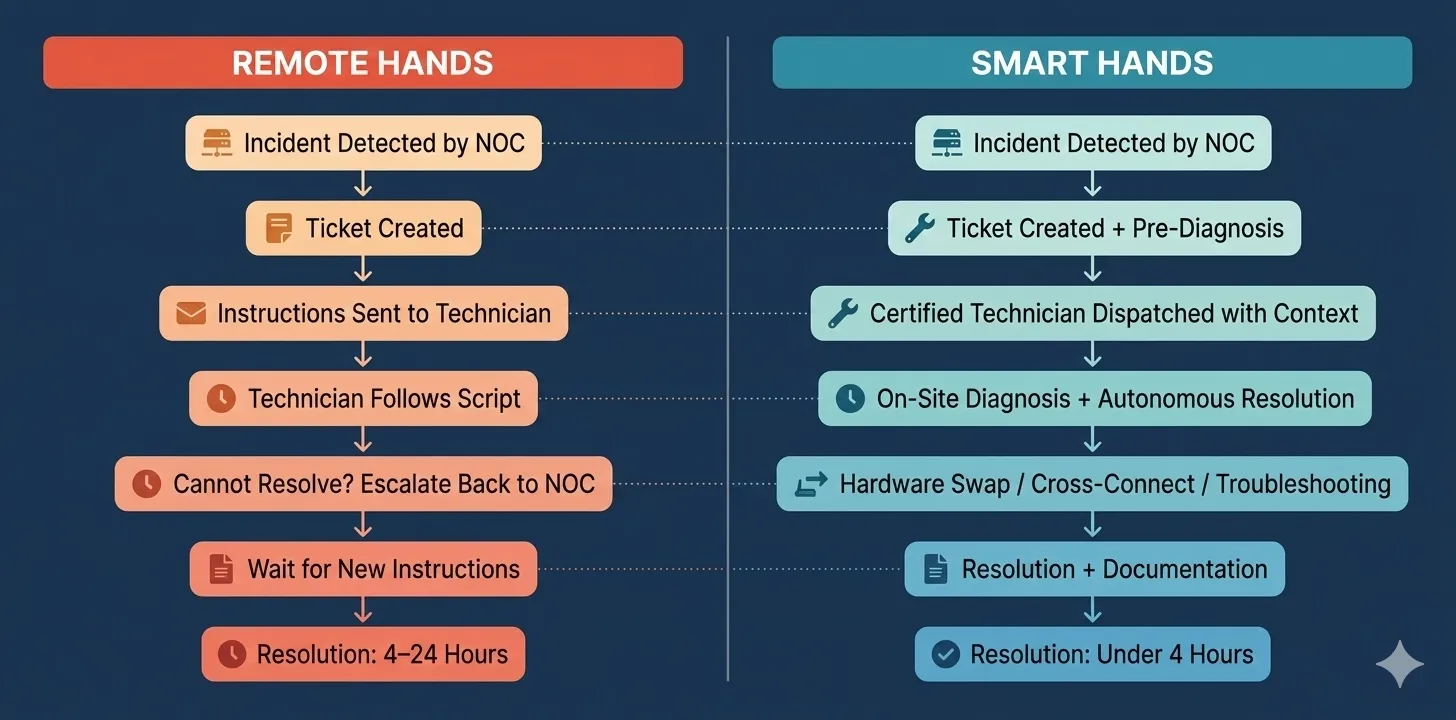
In essence, remote hands is the baseline on-site support model offered by nearly all colocation providers. In this model, a technician responds to a client request — typically routed through a ticketing system or NOC — and performs a specific, pre-defined physical task under instruction. For example, common tasks include: rebooting a server, checking indicator lights, reseating a cable, reporting a visual status, or confirming power delivery to a rack.
Above all, the critical characteristic is that the technician follows explicit directions. In other words, they are the physical extension of a remote engineer’s hands. As a consequence, they do not diagnose, troubleshoot, or make autonomous decisions. Therefore, remote hands is reactive, task-specific, and appropriate for low-complexity requests where the client’s NOC or engineering team retains full diagnostic authority.
Smart Hands
Smart hands elevates the model. A smart hands technician is a trained, often certified professional who can diagnose hardware problems, execute structured cabling work, perform hardware swaps and RMA processing, install cross-connects, conduct basic OS-level or network-layer troubleshooting, and respond to complex incidents with a degree of autonomy.
In the context of smart hands vs. remote hands, the distinction is: skill level, scope of decision-making authority, and the complexity of tasks handled.
Key Differences That Matter Operationally
For decision-makers, the comparison isn’t abstract—it maps directly to your incident response chain, your SLA commitments, and your staffing model.
| Dimension | Remote Hands | Smart Hands |
| Technician skill level | General, non-specialized | Certified (BICSI, CompTIA, OEM) |
| Task complexity | Low (visual checks, reboots, patching) | High (hardware swap, cross-connects, troubleshooting) |
| Decision authority | None — follows instructions only | Yes — diagnoses and resolves autonomously |
| SLA response time | Typically 4–24 hours (business hours) | Typically 1–4 hours, 24×7 |
| Escalation role | Acts on NOC instructions | Can escalate or resolve independently |
| Cost model | Low per-ticket / hourly | Higher; SLA retainer or bundled |
| Appropriate for | Routine tasks, planned changes | P1/P2 incidents, complex deployments |
| Hyperscale fit | Limited | Essential |
Key takeaway: For environments with high rack density, frequent change cycles, mixed-vendor hardware, and aggressive uptime requirements, remote hands alone creates a systematic gap in your physical-layer incident response.
Why Hyperscale Data Centers Have Different Requirements
Hyperscale data centers — whether operated by cloud providers, large enterprises, or wholesale colo tenants — are defined by density, complexity, and continuous deployment cycles. For this reason, the operational profile is fundamentally different from a traditional enterprise data center.
To illustrate, consider the environment: tens of thousands of servers, multiple network fabric layers, frequent hardware additions as workloads scale, multi-vendor equipment from dozens of suppliers, and an expectation of continuous availability measured in ‘nines.’ Given these conditions, every physical layer event — a failed NIC, a broken fiber, a mislabeled cross-connect — has downstream consequences that propagate faster and farther than in a smaller facility.
Three factors make data center on-site support more demanding in hyperscale contexts:
Incident velocity: Larger environments generate more physical incidents per unit time. A reactive model that works for 50 racks fails for 5,000.
Change frequency: Hyperscalers don’t deploy in batches. Hardware arrives and gets racked on a near-continuous basis, requiring skilled hands capable of executing structured cabling, firmware flashing, and cross-connect installation.
SLA pressure: Cloud tenants and enterprise clients expect sub-2-hour resolution for P1 events. That window only works if certified technicians are already present—not being mobilized.
The answer is not simply ‘hire more remote hands.’ It’s a qualitatively different model: resident certified engineers operating under formal SLA commitments, with clearly defined escalation paths and documented technical scope. This is what FLM services deliver.
The FLM Services Factor: Why First Line Maintenance Is Growing
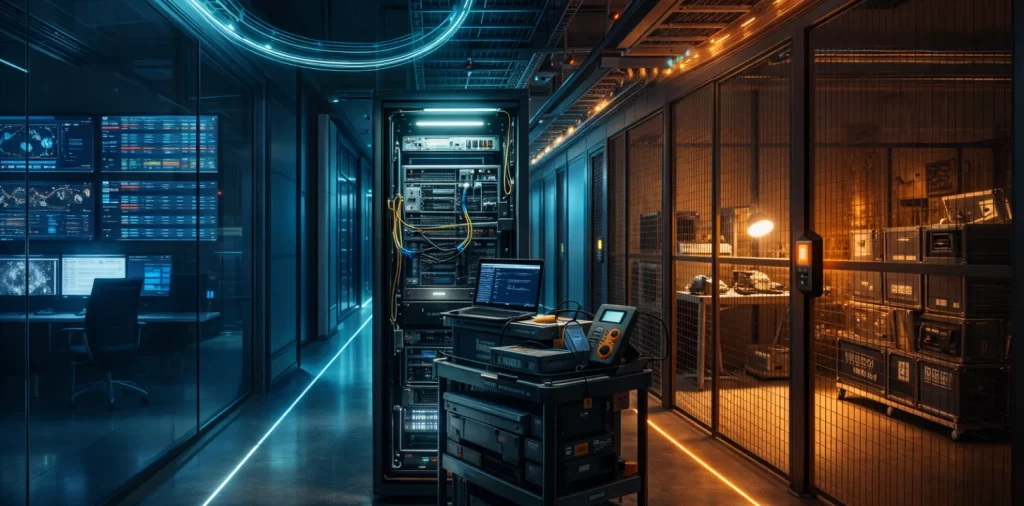
FLM—First Line Maintenance—is the formal, structured evolution of smart hands. While ‘smart hands‘ often refers to a reactive on-demand service, FLM is typically a contractual program in which a provider maintains resident or rapid-response certified technicians whose scope, SLAs, and escalation procedures are explicitly defined.
FLM services programs typically include: preventive maintenance routines, hardware swap and RMA coordination, structured cabling management, vendor liaison and dispatch coordination, and documented incident response with defined MTTR targets. In many hyperscale deployments, FLM bridges the gap between the colocation provider’s baseline obligations and the tenant’s operational requirements.
The market trend is clear—demand for on-site FLM services is accelerating as hyperscale deployments scale and enterprises reduce their own field engineering headcount.
Smart Hands Decision Framework: When to Upgrade from Remote to Smart
Use this framework to determine whether your environment requires smart hands / FLM services rather than standard remote hands coverage.
Trigger Criteria — Upgrade to Smart Hands if ANY of the following apply:
- P1 SLA ≤ 2 hours: Your uptime commitments require physical incident response in under two hours, around the clock.
- Hardware RMA volume > 5/month: Frequent hardware replacements require OEM knowledge and RMA processing capability.
- Cross-connect or cabling changes > 4/month: Requires BICSI-certified or equivalent technicians.
- Multi-vendor environment: Your stack includes hardware from 3+ OEMs, requiring multi-platform diagnostic skills.
- No resident field engineering team: Your organization relies entirely on third-party support.
- Compliance requirements: Regulated workloads require documented, auditable incident response with certified responders.
- Continuous deployment model: New hardware is being added or reconfigured on a weekly or daily basis.
If 3 or more boxes are checked: Smart hands or a formal FLM services engagement is operationally necessary, not optional.
Common Pitfalls When Choosing On-Site Data Center Support
Assuming remote hands will scale. Remote hands is designed for infrequent, simple tasks. Organizations that expand from 2 racks to 200 while keeping the same support model discover—usually during an incident—that response time degrades and task complexity exceeds what their provider can handle.
Underspecifying SLAs. A contract that says ‘best effort’ or ‘next business day’ for on-site response is not a data center on-site support SLA—it’s an opt-out clause. Require explicit response time commitments with financial consequences for breach.
Conflating NOC support with on-site support. NOC teams provide remote monitoring and triage. They cannot replace a cable. Many organizations mistake robust NOC coverage for complete incident response—until a physical event occurs.
Ignoring technician certification requirements. A smart hands provider who cannot demonstrate technician certifications is offering rebranded remote hands at a higher price. Require documentation.Not defining scope of autonomy. Without a written SoW specifying what tasks a technician can perform without client authorization, you will face delays when technicians escalate routine tasks unnecessarily.
Best Practices for Structuring On-Site Data Center Support
Define a tiered task taxonomy. Create a three-tier system: Tier 1 (no authorization needed), Tier 2 (pre-authorized), Tier 3 (requires escalation). Align your SLA commitments to each tier.
Require resident or rapid-response coverage. For hyperscale environments, dispatching a technician from a pool adds 30–90 minutes to every P1 response. Resident or on-campus certified engineers eliminate that lag.
Standardize on FLM services with documented MTTR targets. A mature FLM services program includes defined MTTR by incident priority, monthly reporting, and root-cause documentation—essential for continuous improvement and compliance audits.
Integrate smart hands into change management. Planned change management—scheduled cabling, rack expansions, hardware additions—should be coordinated through a formal process with your on-site support provider.
Audit provider certifications annually. Technician turnover is real. Require quarterly staffing attestations as a contractual deliverable.
Conclusion
The smart hands vs. remote hands question is ultimately about operational risk. Remote hands is adequate for low-complexity, low-urgency physical tasks in stable environments. But for hyperscale data centers—where incident velocity is high, change cycles are continuous, and SLA expectations are aggressive—remote hands is insufficient by design.
Smart hands and formal FLM services exist to close that gap: certified technicians, resident or near-resident, operating under contractually defined SLAs with documented escalation paths. As hyperscale capacity continues to grow and organizations reduce their own field engineering presence, the market for third-party on-site support will expand accordingly.
The organizations that build this capability correctly don’t wait for a P1 event to discover the gap. They define their requirements, qualify their providers, and build SLA structures that hold under pressure.
Frequently Asked Questions
What is the main difference between smart hands and remote hands?
Remote hands technicians follow explicit client instructions to perform simple, pre-defined physical tasks — reboots, cable checks, visual inspections. Smart hands technicians are certified professionals who can diagnose problems, replace hardware, install cross-connects, and resolve complex physical-layer incidents with technical autonomy. The difference is skill level and decision-making authority.
When does a data center need smart hands instead of remote hands?
You need smart hands when your SLA demands sub-2-hour on-site response, when hardware RMAs or cross-connect installations are frequent, when your environment includes multi-vendor equipment requiring diagnostic expertise, or when your organization does not maintain resident field engineers. If three or more of these conditions apply, smart hands is the appropriate model.
What are FLM services in a data center context?
FLM (First Line Maintenance) is a formal, contractual on-site support program in which a provider maintains certified resident or rapid-response technicians with defined SLAs, documented scope of work, escalation procedures, and MTTR commitments. It is the structured, enterprise-grade version of smart hands services.
Can a colocation provider’s standard remote hands cover hyperscale needs?
In most cases, no. Standard colocation remote hands is designed for low-complexity tasks and typically operates on next-business-day or best-effort timelines. Hyperscale environments require 24×7 certified on-site coverage with P1 response windows measured in minutes, not hours.
What certifications should a smart hands technician have?
Relevant certifications include BICSI RCDD or DCDC (structured cabling), CompTIA Network+ or Server+, OEM hardware certifications (Dell, HPE, Cisco, etc.), and facility-specific safety credentials. For FLM engagements, require that certifications are documented in the SoW and attested quarterly.
How is smart hands priced compared to remote hands?
Remote hands is typically billed hourly or per-ticket at low rates, often included in colocation contracts. Smart hands and FLM services are usually structured as monthly retainers tied to SLA tiers, or premium per-incident rates with defined response guarantees. The price premium reflects technician skill level and SLA commitment.
What SLA response times are realistic for smart hands in hyperscale?
Best-in-class programs offer P1 on-site response within 30–60 minutes for resident technicians, or 90–120 minutes for rapid-response models. Anything beyond 2 hours for a P1 event is difficult to justify in a hyperscale environment.
How do smart hands integrate with a NOC?
Smart hands technicians operate as the physical execution layer within the NOC’s incident management process. The NOC detects and triages alerts, creates tickets, and escalates to on-site smart hands for physical intervention. In mature FLM programs, technicians may have direct NOC access to close tickets after resolution.
Does my colocation provider’s smart hands replace my own field engineers?
For many enterprises, yes. A well-scoped FLM services engagement can fully replace the need for resident field engineers while providing documented SLAs, certified expertise, and scalable coverage across multiple facilities.
What should be in a smart hands Statement of Work (SoW)?
A strong SoW should include: task taxonomy, SLA response times by priority tier, technician certification requirements, escalation path and NOC integration, MTTR reporting obligations, spares management procedures, and financial penalties for SLA breaches.
How is smart hands relevant to compliance and audit requirements?
A formal FLM services engagement provides naturally auditable documentation: incident tickets, technician IDs, timestamps, task logs, and MTTR reports. Remote hands arrangements rarely produce this level of auditability required by regulated industries.
Is ‘smart hands’ a standardized term across the industry?
No. Providers define the term very differently. Always request a written task taxonomy when evaluating providers to understand what is actually included in their smart hands offering.
Outros Blogs